The Hidden Contamination in Your Storage Tank: What Kenyans Drink Without Knowing
22, Jun 2026
Bottled water has one of the most successful marketing stories in history. The clear plastic, the pristine mountain imagery, the promise of purity. Millions of Kenyans pay a significant premium for it every month, confident they are getting something cleaner and safer than tap water. The evidence suggests otherwise.
Research into bottled water quality has produced findings that the industry would prefer you did not read. A landmark 2018 study by Orb Media, conducted across 11 major bottled water brands sold in nine countries, found that 93% of bottles tested contained microplastic contamination. The average bottle contained 325 microplastic particles per litre.
Separate studies have identified coliform bacteria, including strains of E. coli, in commercially bottled water products. A study published in the journal Environmental Science and Technology found that the longer water sits in a plastic bottle, especially in warm conditions, the greater the leaching of chemical compounds including antimony and BPA into the water itself.

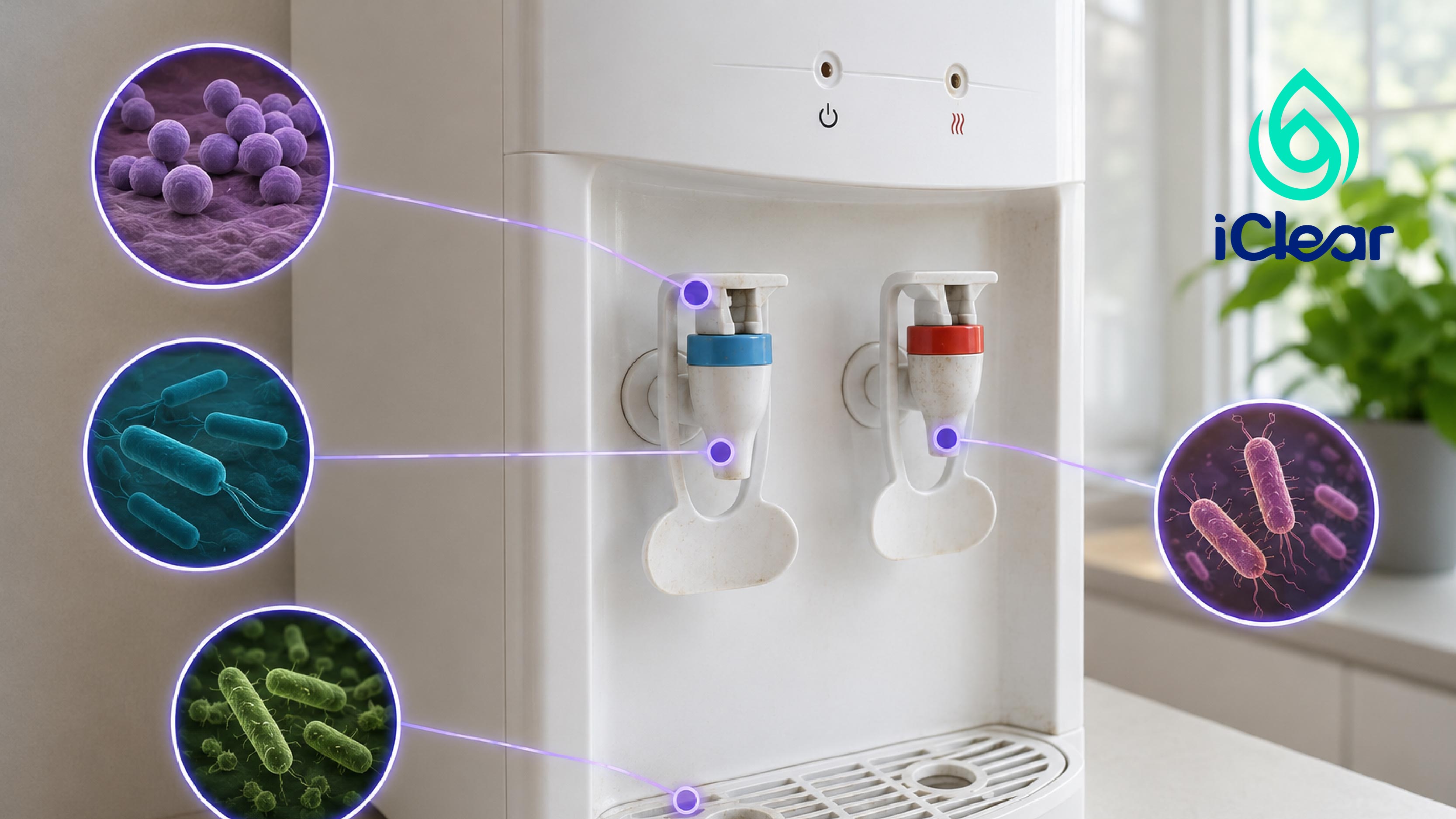
Water dispenser with bacteria infographic
93% of major bottled water brands tested contained microplastic particles. The average was 325 particles per litre. You cannot see them. You cannot taste them. And you are drinking them.
Storage and heat exposure
Kenya's climate accelerates the chemical breakdown of plastic bottles. When PET bottles are exposed to heat, whether in a delivery truck, a warehouse, or direct sunlight outside a shop, the plastic begins to leach compounds into the water. BPA and phthalates, both of which are linked to hormonal disruption and long-term health effects, are released at higher rates as temperature increases. The water in that bottle sitting in the sun outside a Nairobi duka is not the same as what left the factory.
Reuse of single-use bottles
A common practice across Kenyan homes and offices is the refilling of single-use plastic bottles, either from dispensers, taps, or 20-litre delivery containers. Single-use PET bottles are designed for one fill. Each refill and wash degrades the plastic further, increasing leaching. The bacteria that accumulate in the neck and cap of a repeatedly used bottle are a contamination source in their own right.
20-litre dispenser bottles and hygiene
The large 20-litre bottles used in office and home water dispensers present their own hygiene challenges. These bottles are collected, washed, refilled, and redistributed by suppliers, and the quality of that washing process is entirely beyond the consumer's visibility. Studies on refillable water containers have found bacterial contamination in a significant proportion of bottles in active circulation.
Regulatory gaps
In Kenya, bottled water is regulated but enforcement varies significantly across producers. Smaller, informal bottling operations that supply local markets may meet KEBS standards on paper while operating with inadequate quality control in practice. The consumer has no reliable way to distinguish a rigorously tested product from one that is not.
You pay a premium for bottled water on the assumption that someone else has ensured its safety. But between the factory, the warehouse, the delivery truck, and your shelf, that assumption takes a lot on trust.
A growing number of Kenyan households and businesses are switching from bottled water to point-of-use water purification machines, systems that purify water at the moment you drink it, with no storage, no plastic, and no supply chain involved.
The iClear water purifier uses multi-stage Reverse Osmosis filtration to produce water that consistently meets or exceeds bottled water quality standards, without microplastics, without chemical leaching from plastic, and without the hygiene uncertainty of the bottled water supply chain. The water it produces is tested to KEBS certification standards and delivered fresh, on demand, directly from your tap.
For most Kenyan households, switching to iClear also saves money. The average household spending KES 3,000 to 8,000 per month on bottled water eliminates that cost entirely after purchasing an iClear system, with free delivery and professional installation included in Nairobi, its environs, and Nakuru.
The cleanest water is not the one that travels furthest in a plastic bottle. It is the one purified at the point of use, on demand, by a system you control. That is exactly what iClear delivers.
Stop paying for water you cannot fully trust.
Contact iClear Kenya today and make the switch to certified, on-demand pure water. Free delivery and installation in Nairobi and Nakuru.
Tags: water purifier Kenya, iClear water, water purification machine, water filter Kenya, iClear Kenya, iClear Wellife, bottled water Kenya

Water Purification & Treatment Specialists
David Ochieng, a water purification specialist at iClear Wellife Services Ltd, has extensive experience delivering safe and reliable water treatment solutions for homes and offices across Kenya.