Why Is My RO Purifier Producing Less Water Than It Used To?
22, Oct 2026
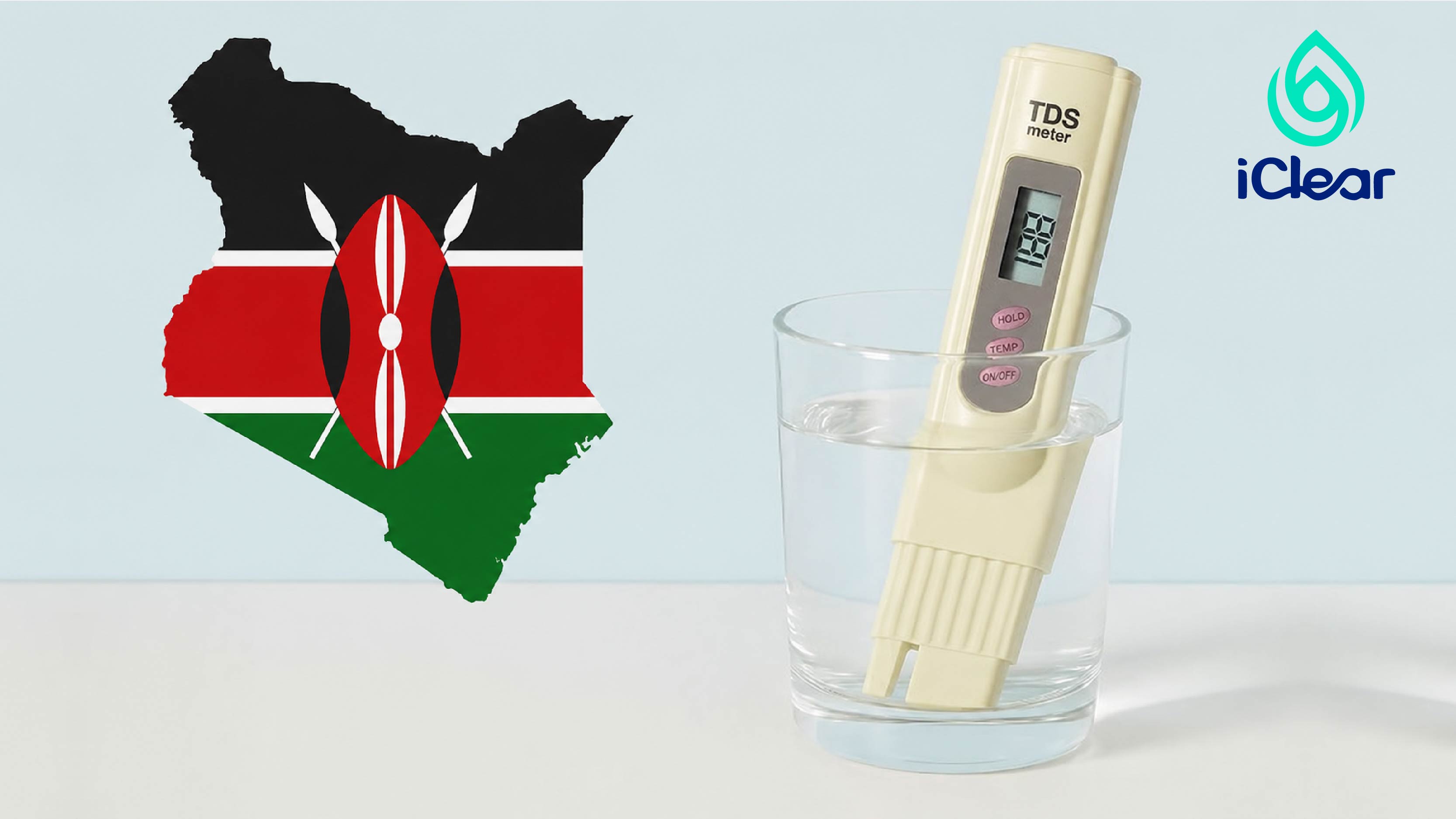
There is no shortage of opinions about Kenyan water quality. What there is a shortage of is data. Across the towns where iClear's technical team has tested water this year, we have collected real Total Dissolved Solids readings from real boreholes, taps, and storage tanks. Here is what those numbers show.
Total Dissolved Solids, or TDS, is a measure of everything dissolved in your water, including salts, minerals, metals, and other substances. It is one of the most useful single indicators of overall water quality, because it captures the contaminants that visual inspection misses entirely.
As a general guide:
These are general benchmarks. The specific composition of the TDS, fluoride, salts, metals, also matters significantly for health.
Here are the typical TDS readings from iClear's field testing across Kenyan towns this year:
Karen:
Typical range: 150 to 180 ppm. The lowest TDS in our regular testing. Reflects Karen's mix of newer infrastructure and relatively well-maintained boreholes.
Ruiru:
Typical range: 220 to 300 ppm. Within acceptable drinking water range but worth filtering, particularly for dissolved minerals.
Naivasha:
Typical range: 300 to 600 ppm. The upper end is borderline. Naivasha is also a high-fluoride area, which compounds the TDS concern.
Kitengela:
Typical range: 450 to 600 ppm. Consistently elevated. Boreholes in this area frequently combine high TDS with elevated fluoride.
Kajiado:
Typical range: 450 to 600 ppm. The highest TDS readings our team has consistently recorded. Kajiado County contains some of the most challenging borehole water in our service area.
The numbers vary by source, by season, and by individual borehole. What is consistent is that without testing, most households have no idea where their water sits on this scale.
If you live in Karen or Lavington on municipal supply, your TDS is probably acceptable, though it does not capture chlorine, bacteria from storage tanks, or other concerns. If you live in Kitengela or Kajiado on a borehole, your TDS is almost certainly elevated, and likely paired with elevated fluoride or other dissolved contaminants.
In every case, the only way to know your specific reading is to test your specific water source. The figures here are typical ranges from our field experience. Your individual borehole or tank may sit at the higher or lower end.
A Reverse Osmosis system reduces TDS dramatically, typically by 90% or more. A borehole reading of 600 ppm before treatment will commonly come out below 50 ppm after RO. That is the difference between water that is borderline and water that is genuinely pure. The iClear Standard and iClear Premier are designed specifically for the kinds of TDS levels our field team encounters across Kenya, including the high-end Kitengela and Kajiado readings.
The honest TDS map of Kenya is not one of clean tap water and dirty rivers. It is one of dramatically different readings town by town, borehole by borehole, with most households having no idea where they sit on the scale. The first step is knowing your number. The second is doing something about it.
Find out where your water sits on the TDS map.
Free delivery and professional installation in Nairobi and Nakuru. Visit the iClear shop.
Tags: TDS Kenya, TDS borehole water, Kitengela water, Kajiado water, Naivasha water, Karen water, Ruiru water, water purifier Kenya, iClear Kenya

Water Purification & Treatment Specialists
David Ochieng, a water purification specialist at iClear Wellife Services Ltd, has extensive experience delivering safe and reliable water treatment solutions for homes and offices across Kenya.