


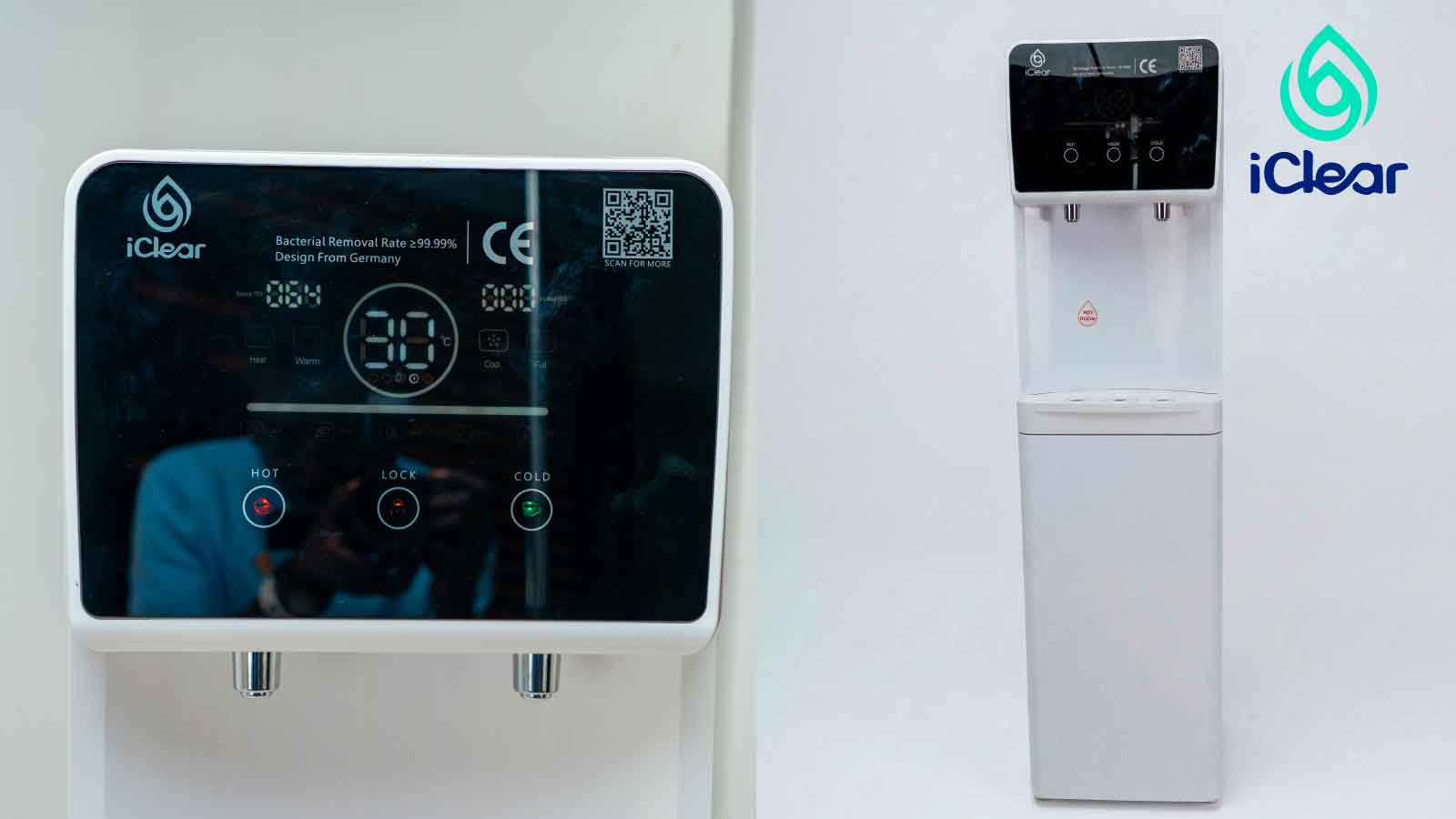
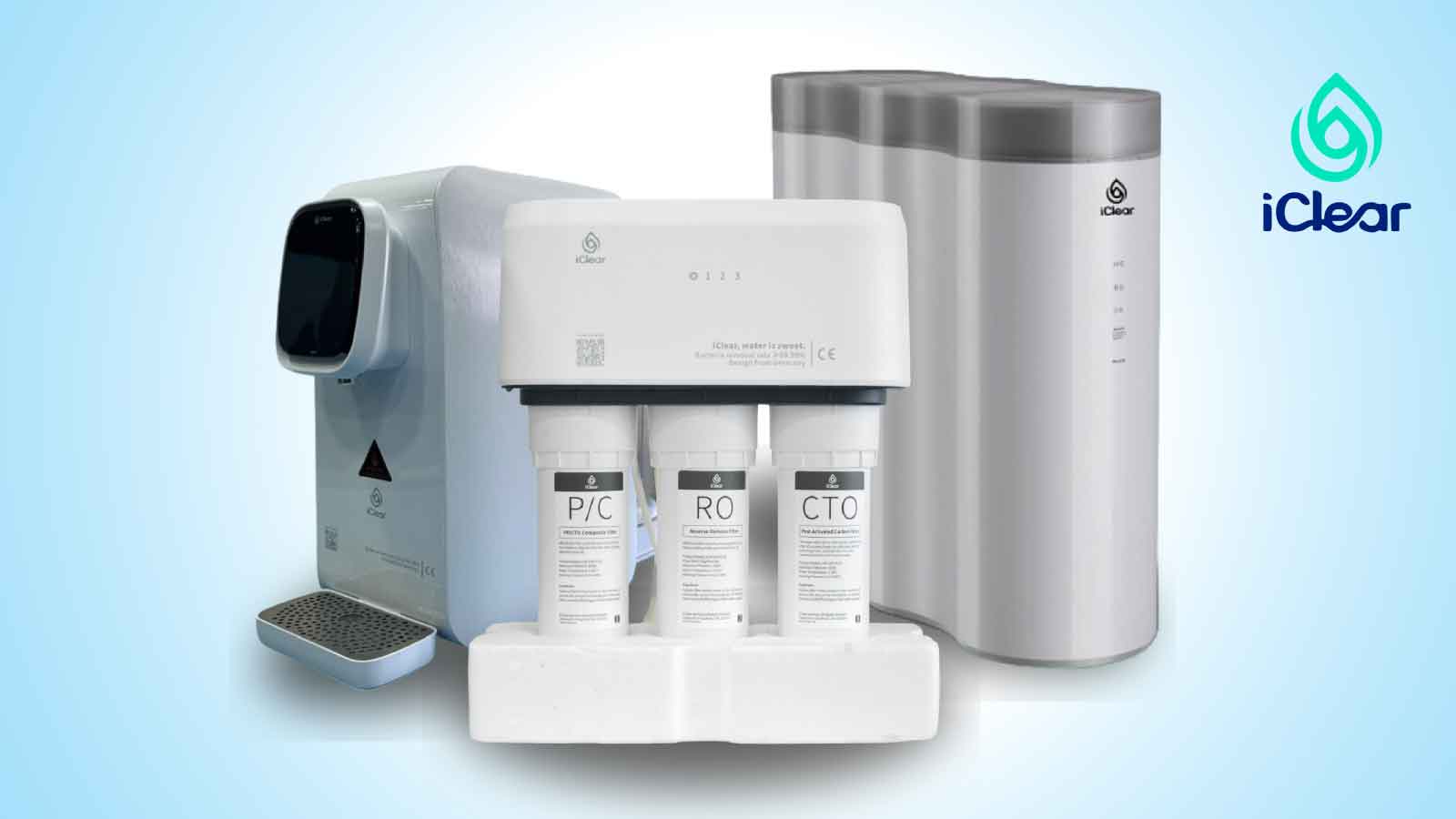
Quick Answer A water purifier dispenser is a single machine that both purifies water and dispenses it at your chosen temperature. It is different from an ordinary dispenser, which only stores and serves water without cleaning it. In Kenya, the iClear Desktop (KSh 40,000) is a countertop purifier dispenser with full Reverse Osmosis and instant hot water in 3 seconds, and the iClear Office system (KSh 90,000 per year) is a bottleless purifier dispenser serving 20 to 30 staff hot and cold purified water on demand. Purifier dispenser vs ordinary dispenser: the difference that matters The two machines look similar on a counter. What happens inside them is completely different. An ordinary dispenser holds a bottle or tank of water and changes its temperature. Whatever contaminants are in the water pass straight through to your glass. A purifier dispenser puts the water through genuine purification, in iClear's case multi-stage Reverse Osmosis, before it ever reaches the tap. Capability Ordinary dispenser Purifier dispenser (iClear) Hot and cold serving Yes Yes Removes bacteria and viruses No Yes Removes fluoride No Yes Removes dissolved salts (TDS) No Yes Needs bottled water deliveries Yes No Reservoir hygiene risk High if uncleaned No stored reservoir to contaminate Key Finding: Studies of office water dispensers have found bacterial contamination, including coliforms, in units that passed visual inspection as clean. The reservoir, spigots, and drip tray of a conventional dispenser are contamination points a purifier dispenser simply does not have. The two purifier dispensers iClear makes iClear Desktop: the home and small office purifier dispenser Refilling the Desktop's removable 4-litre tank: no plumbing, no installation, purified water anywhere with a socket. Price KSh 40,000 (free delivery, Nairobi and Nakuru) Purification Full multi-stage Reverse Osmosis Dispensing Instant hot water in 3 seconds, six temperature settings, cold and ambient Setup No plumbing; built-in 4-litre tank; plug and use Best for Homes, apartments, renters, small offices of 1 to 3 regular users The Desktop replaces three appliances at once: the dispenser, the kettle, and the filter. Water is purified through RO, then heated to your selected temperature on demand, suited for tea, coffee, baby formula, or chilled drinking. iClear Office: the workplace purifier dispenser The iClear Office purifier dispenser: bottleless, floor-standing, with hot, lock, and cold controls. Price KSh 90,000 per year (annual agreement) Purification Bottleless RO plus UV Dispensing Unlimited hot and cold, safety lock on hot tap Servicing Free professional servicing every four months, included Best for Offices of 20 to 30 staff replacing bottled cooler setups The Office system connects directly to your water supply, which removes bottles, deliveries, storage, and the hygiene risks of bottle-fed coolers in one move. For a typical office spending KSh 12,000 to 20,000 per month on bottled water, the agreement usually costs less than the bottles it replaces. Who should buy a purifier dispenser instead of separate machines Households that boil water daily for tea, formula, or drinking: the Desktop collapses that routine into a 3-second dispense of already-purified hot water. Renters who cannot install plumbed systems but want genuine purification with dispensing convenience. Offices running bottled coolers: a purifier dispenser removes the recurring cost and the reservoir hygiene problem simultaneously. Anyone comparing a dispenser and a purifier as separate purchases: the combined machine is usually cheaper than buying both and eliminates the unpurified-dispenser risk entirely. FAQ Q: What is a water purifier dispenser? A: A single machine that purifies water and dispenses it at selected temperatures. Unlike an ordinary dispenser, which only stores and serves water, a purifier dispenser removes contaminants first. The iClear Desktop uses full Reverse Osmosis before dispensing hot, ambient, or cold water. Q: How much does a water purifier dispenser cost in Kenya? A: The iClear Desktop costs KSh 40,000 with free delivery in Nairobi and Nakuru. For offices, the iClear Office purifier dispenser is KSh 90,000 per year including installation and servicing every four months. Q: Does a purifier dispenser need plumbing? A: The iClear Desktop does not: it has a built-in 4-litre tank you fill manually, so it works anywhere with a power socket. The iClear Office system connects to your supply line and is professionally installed free in Nairobi, its environs, and Nakuru. Get one machine that purifies and dispenses. Free delivery and professional installation in Nairobi and Nakuru. Visit the iClear shop. Keywords: water purifier dispenser, water purifier and dispenser, hot water dispenser Kenya, water dispenser purifier, iClear Desktop, iClear Kenya, purifier dispenser for home
Quick Answer Reverse Osmosis (RO) purifies water by forcing it through a membrane whose pores are small enough to block dissolved salts, fluoride, heavy metals, bacteria, and viruses, while letting water molecules through. It is the only widely available technology that removes the full range of contaminants found in Kenyan water, and it typically reduces TDS by 90% or more. You need it if your home uses borehole, salty, or high-fluoride water. You may not need it if your municipal water is already low-TDS and you only want better taste. How Reverse Osmosis actually works Every RO system does the same core job in stages: Stage 1, pre-filtration: sediment and carbon filters remove particles, rust, and chlorine. This protects the membrane and handles the visible part of the problem. Stage 2, the RO membrane: water is pushed under pressure through a semi-permeable membrane with pores measured in fractions of a nanometre. Dissolved salts, fluoride ions, heavy metals, bacteria, and viruses are physically too large to pass. They are flushed away as reject water. Stage 3, post-filtration and storage: a polishing filter refines taste, and in plumbed systems, a pressure tank stores purified water so it is instantly available at the tap. The stages made visible: the iClear Standard's labelled P/C composite pre-filter, RO membrane, and CTO post-carbon filter. The critical distinction from every other filter type is that RO works at the molecular level. Carbon, ceramic, and UV all operate above it, which is why they cannot remove anything dissolved. Why RO matters more in Kenya than almost anywhere The case for RO in Kenya is not theoretical. It is in the measurements iClear's field team takes every week: Key Finding: Our highest fluoride reading in Rift Valley borehole water exceeded 8.75 mg/L, more than 5 times the WHO safe limit of 1.5 mg/L. Naivasha, Nakuru, Kajiado, Gilgil, and Kitengela all show consistently elevated fluoride. No amount of boiling, carbon filtering, or UV treatment reduces it. Only RO does. Figure 1: iClear's highest field fluoride measurement against the WHO safe limit. The same is true of dissolved salts. Borehole TDS in our field tests runs from 150 ppm in Karen to 600 ppm in Kitengela and Kajiado. Boiling concentrates these contaminants rather than removing them, because the water evaporates and the dissolved load stays behind. Boiling kills bacteria but makes dissolved contamination worse: as water boils off, fluoride and salts become more concentrated in what remains. For borehole households, boiling is not a safety strategy. It is a false comfort. What RO removes, by the numbers Contaminant Typical Kenyan source Boiling Carbon UV Reverse Osmosis Bacteria & viruses Storage tanks, supply Yes Partial Yes Yes Fluoride Rift Valley geology No No No Yes Dissolved salts (TDS) Boreholes, coastal water No No No Yes Heavy metals Ageing pipes, geology No No No Yes Sediment & rust Tanks, old plumbing No Partial No Yes A well-installed RO system typically reduces TDS by 90% or more. A Kitengela borehole reading 600 ppm before treatment will commonly come out below 50 ppm after RO, which is the difference between water that strains the body over time and water that is genuinely pure. When you actually need RO, and when you do not You need RO if: your water comes from a borehole anywhere in Kenya; your water tastes salty or mineral-heavy; you live in or near a known high-fluoride area (Naivasha, Nakuru, Kajiado, Gilgil, Kitengela); or your household includes children, whose developing teeth and bones absorb fluoride fastest. You may not need RO if: your municipal supply tests consistently low-TDS, your storage tank is professionally maintained, and your only complaint is chlorine taste. In that narrow case, a quality carbon filter improves taste for less. Most Kenyan homes are not in that case. What an iClear RO system includes Every iClear system is a full multi-stage RO purifier, KEBS-certified, with free delivery and professional installation in Nairobi, its environs, and Nakuru. The Standard (KSh 25,000) suits everyday households, the Premier (KSh 49,000) delivers 7,200 litres per day for households of 8 to 15, the Desktop (KSh 40,000) provides portable RO with instant hot water for renters, and the Office system (KSh 90,000 per year) serves 20 to 30 staff with servicing included every four months. A standard home installation takes 30 to 45 minutes. FAQ Q: What does reverse osmosis remove from water? A: Dissolved salts, fluoride, heavy metals (including lead and arsenic), nitrates, bacteria, viruses, and sediment. In iClear installations, RO typically reduces TDS by 90% or more, taking a 600 ppm borehole reading below 50 ppm. Q: Does reverse osmosis remove fluoride? A: Yes, and it is the only common household technology that does. Fluoride ions cannot pass the RO membrane. This matters acutely in Kenya, where iClear has measured borehole fluoride above 8.75 mg/L against a WHO limit of 1.5 mg/L. Q: Is RO water safe to drink every day? A: Yes. RO water is purified water. It contains dramatically fewer dissolved minerals than untreated water, and a normal diet supplies the minerals the body needs. For high-fluoride and high-TDS areas of Kenya, daily RO water is not just safe but protective. Q: How much does a reverse osmosis machine cost in Kenya? A: iClear's 2026 RO range runs from KSh 25,000 (Standard) to KSh 49,000 (Premier) for homes, KSh 40,000 for the portable Desktop, and KSh 90,000 per year for the Office system, all including free delivery and professional installation in Nairobi and Nakuru. Get Reverse Osmosis built for Kenyan water. Free delivery and professional installation in Nairobi and Nakuru. Visit the iClear shop. Keywords: reverse osmosis water treatment, reverse osmosis Kenya, ro water purifier, reverse osmosis water filter, RO system Kenya, iClear Kenya, fluoride removal Kenya
Quick Summary Across four years and more than 12,000 families served in 5+ countries, the most consistent things iClear customers report are: an immediate difference in taste, shock at what the first filter reveals about their old water, and one recurring sentiment: they wish they had switched sooner. Below are real customer words, what drives them, and the honest picture of who iClear is and is not for. What customers say about the water "Since I installed the iClear purifier in my home, we now feel the difference in taste as a lot of impurities are removed and we can drink water directly from the tap." iClear customer review, iclear.co.ke "This thing has changed my life." iClear customer review, iclear.co.ke Taste is the first thing customers notice, usually within the first glass. The reason is measurable: Reverse Osmosis typically cuts TDS by 90% or more, and in the towns where iClear works, the starting readings run from 150 ppm in Karen to 600 ppm in Kitengela and Kajiado boreholes. Removing that dissolved load changes how water tastes in a way customers describe without prompting. "My water tastes funny" usually traces to elevated TDS or chlorine residues. "My borehole water is too salty" matches the 450 to 600 ppm readings common in Kitengela and Kajiado. "I want safe drinking water for my family" is the most common reason of all, and the one the field data most strongly supports: our team has measured fluoride above 8.75 mg/L in Rift Valley boreholes, more than five times the WHO safe limit. Key Finding: The biggest referral engine in iClear's four years has not been advertising. It is neighbours: "My neighbour saw the system and wanted one too" is a recurring line from new customers, and young families, borehole-estate tenants, landlords, offices, and dental clinics make up the core customer base. The honest picture: who iClear is and is not for iClear is for you if: your home runs on borehole, salty, or uncertain municipal water; you want certified purification with installation handled; or your office wants to eliminate bottled water. The Standard, Premier, Desktop, and Office system cover those cases at KSh 25,000 to KSh 90,000. Look elsewhere if: you only want a cheap taste improvement on already-clean municipal water (a basic carbon jug does that for less), you live outside iClear's free installation zone and prefer a local installer, or you are building a water vending business, which commercial equipment providers serve better. FAQ Q: Are iClear water purifiers good? A: Customer feedback centres on three things: a clear taste difference from day one, fast and free professional installation (30 to 45 minutes in Nairobi and Nakuru), and reliable after-sales support. Every product is KEBS-certified, and iClear serves over 12,000 families across 5+ countries after four years of operation. Q: Where can I read iClear reviews? A: Customer testimonials are published on iclear.co.ke, and this page collects representative reviews alongside the recurring feedback themes iClear's field team records during installations. Q: What do customers complain about? A: The most common pre-purchase concerns are cost, maintenance, electricity use, and filter replacement costs. Post-installation, the recurring sentiment is not a complaint but a regret: that they waited years longer than they needed to. Join 12,000+ families drinking genuinely clean water. Free delivery and professional installation in Nairobi and Nakuru. Visit the iClear shop. Keywords: iclear water reviews, iClear reviews Kenya, iClear water purifier reviews, iClear Kenya, water purifier reviews Kenya, iClear customer feedback
Quick Answer: What Water Purifiers Cost in Kenya Genuine Reverse Osmosis water purifiers in Kenya range from KSh 25,000 to KSh 90,000 depending on capacity and use case. iClear's current 2026 prices: Standard KSh 25,000, Desktop KSh 40,000, Premier KSh 49,000, and the Office system at KSh 90,000 per year on an annual agreement. Every iClear price includes free delivery and professional installation in Nairobi and Nakuru, plus a 1-year warranty. 2026 price list: what each system costs and includes System Price (KSh) Best for What is included iClear Standard 25,000 Everyday households; borehole, salty, municipal water Full RO system, pressure tank, free delivery + installation, 1-yr warranty iClear Desktop 40,000 Renters, apartments, small offices; no plumbing Portable RO, instant hot water (6 settings), 4L tank, free delivery iClear Premier 49,000 Households of 8 to 15; small offices High-capacity RO (7,200 L/day), pressure tank, free delivery + installation, 1-yr warranty iClear Office 90,000 / year Offices of 20 to 30 staff Bottleless RO + UV, hot & cold, free installation, free servicing every 4 months Prices verified from iclear.co.ke in July 2026. Confirm current pricing on the shop page before purchase, as promotions run periodically. The iClear Desktop (KSh 40,000) with its removable 4-litre tank: portable RO with no plumbing required. What drives the price differences The spread from KSh 25,000 to KSh 90,000 is not branding. Each step up buys a specific capability: Capacity: the Premier's 100 gallon (7,200 litre) daily output roughly doubles the throughput of the Standard, which is why it serves households of 8 to 15 people. Features: the Desktop adds instant heating with six temperature settings and full portability, replacing both a purifier and a kettle. Service model: the Office system's annual price includes professional servicing every four months, converting maintenance from your problem into part of the agreement. Key Finding: Across the Kenyan market, the single largest hidden cost is installation. Many brands quote a machine price that excludes it. Every iClear price above includes professional installation by iClear technicians in Nairobi, its environs, and Nakuru, which no other water purifier brand in Kenya currently offers as standard. The real comparison: what you are already spending The most useful way to judge a purifier's price is against what a household spends without one. A typical Kenyan family buying bottled water spends KSh 3,000 to 8,000 per month, which is KSh 36,000 to 96,000 every year. Over five years, that is between KSh 180,000 and KSh 480,000 spent on water, against a one-time KSh 25,000 for an iClear Standard. Figure 1: Cumulative 5-year spend on bottled water versus a one-time iClear Standard purchase. On these numbers, the Standard pays for itself in roughly 4 to 8 months of bottled water savings, and iClear's own estimate is that customers save up to 80% compared to bottled water. Filter replacements add a modest ongoing cost, scheduled and supported by iClear's service team, but the overall picture does not change: for most households, the purifier is not an expense. It is the cheaper option. Price traps to avoid A low machine price with installation excluded: get the total installed cost in writing before comparing. Uncertified units at attractive prices: a system that does not remove what it claims is wasted money at any price. Ask for KEBS certification documentation. No after-sales structure: replacement filters that are hard to source or unpriced at purchase become expensive later. Marketplace listings without support: the price may be real, but installation, warranty handling, and servicing land entirely on you. FAQ Q: How much does a water purifier cost in Kenya? A: Genuine RO water purifiers cost from KSh 25,000 to KSh 90,000 in 2026. iClear's range: Standard KSh 25,000, Desktop KSh 40,000, Premier KSh 49,000, and the Office system at KSh 90,000 per year including quarterly servicing. All include free delivery and professional installation in Nairobi and Nakuru. Q: Is an RO system worth the price? A: For most households, yes, on the maths alone. A family spending KSh 3,000 to 8,000 monthly on bottled water spends KSh 36,000 to 96,000 a year. A KSh 25,000 iClear Standard typically pays for itself within 4 to 8 months, then keeps saving every month after. Q: What does installation cost? A: With iClear, nothing. Free professional installation in Nairobi, its environs, and Nakuru is included with every purchase, and a standard home install takes 30 to 45 minutes. With other providers, always confirm whether installation is included before comparing prices. Q: Are there ongoing costs after buying? A: Yes: filters need scheduled replacement to keep any RO system performing. iClear schedules and supports replacements across its range, and the Office agreement includes free servicing every four months. See current prices and choose your system. Free delivery and professional installation in Nairobi and Nakuru. Visit the iClear shop. Keywords: water purifier price in kenya, water filter price in kenya, water purification machine price in kenya, reverse osmosis machine price in kenya, iClear prices, water purifier Kenya
Quick Answer For most Kenyan homes: a KEBS-certified Reverse Osmosis system is the only filter type that removes fluoride, dissolved salts, heavy metals, and bacteria together. Our field team has measured fluoride above 8.75 mg/L in Rift Valley boreholes, which no carbon, ceramic, or UV filter can touch. Best for homeowners: iClear Standard (KSh 25,000, installation included). Best for large households: iClear Premier (KSh 49,000, 6 to 10 people). Best for renters: iClear Desktop (KSh 40,000, no plumbing). How we evaluate water filters iClear's technical team installs and tests water purification systems across Kenya every week, measuring TDS before and after installation with calibrated meters and recording water conditions town by town. Our evaluation of any water filter rests on six criteria: the filtration technology, certification, installation, capacity, after-sales support, and fit for the household's living situation. Key Finding: Across our 2026 field tests, borehole TDS ranged from 150 ppm in Karen to 600 ppm in Kitengela and Kajiado, and our highest fluoride reading exceeded 8.75 mg/L against a WHO safe limit of 1.5 mg/L. A home water filter in Kenya has to be judged against these real conditions, not laboratory ideals. Figure 1: Typical TDS readings from iClear field tests across five Kenyan towns, 2026. Why technology is the first filter Most disappointing water filter purchases in Kenya come down to one mismatch: the technology inside the filter cannot remove what is actually in the water. This chart summarises what each common technology handles. Figure 2: Removal capability by treatment technology. Only Reverse Osmosis covers all five contaminant categories. Boiling and UV kill microbes but leave every dissolved contaminant behind. Carbon improves taste. Ceramic handles sediment and bacteria. Only Reverse Osmosis removes the fluoride and dissolved salts that our field data shows are the defining problems in Kenyan water. For any home on borehole water, RO is the starting requirement, not a premium option. The 3 best home water filter options in Kenya 1. iClear Standard: best overall for Kenyan homes The iClear Standard from every angle: three-stage filter unit with wall-mount back plate. Price KSh 25,000 (free delivery and installation, Nairobi and Nakuru) Technology Multi-stage Reverse Osmosis Best for Everyday households on borehole, salty, rain, or municipal water Certification KEBS certified Warranty 1 year The iClear Standard is built specifically for the water conditions in our field data: salty boreholes, high-fluoride groundwater, and variable municipal supply. Professional installation by iClear technicians is included and takes 30 to 45 minutes. Choose it if: you own your home and want permanent purified water at the best price in the range. Skip it if: your household is above 8 people (see the Premier) or you rent and cannot modify plumbing (see the Desktop). 2. iClear Premier: best for large households The iClear Premier: high-capacity RO in a sealed, compact housing. Price KSh 49,000 (free delivery and installation, Nairobi and Nakuru) Technology High-capacity multi-stage RO Capacity 100 gallons (7,200 litres) per day Best for Households of 6 to 10 people, small offices Certification KEBS certified Warranty 1 year Choose it if: your household is large or you run a small office. Skip it if: you are 1 to 4 people; the Standard covers you at half the price. 3. iClear Desktop: best for renters and small spaces The iClear Desktop's touchscreen: six one-touch temperature presets including Tea, Coffee, Milk, and Hot. Price KSh 40,000 (free delivery, Nairobi and Nakuru) Technology Portable RO with instant heating Features Hot water in 3 seconds, six temperature settings, 4-litre tank Best for Renters, apartments, small offices; no plumbing required Certification KEBS certified Choose it if: you rent, move often, or want instant hot purified water without any installation. Skip it if: your household consumes large volumes daily; the 4-litre tank suits 1 to 3 people best. The comparison at a glance Criterion iClear Equipment groups Importers Marketplace Focus Home & office drinking water Broad water & energy Imported home units Mixed brands RO technology All products Selected products Selected products Varies KEBS certification Yes, all products Check with provider Check with provider Varies by listing Free installation Yes, Nairobi & Nakuru Check with provider Check with provider Rarely Scheduled servicing Yes Check with provider Check with provider Buyer-managed FAQ Q: What is the best water filter for a home in Kenya? A: For most Kenyan homes, a KEBS-certified Reverse Osmosis system. Our field data shows fluoride up to 8.75 mg/L and TDS up to 600 ppm in common borehole sources, and RO is the only technology that removes both alongside bacteria and heavy metals. The iClear Standard (KSh 25,000, installation included) is the strongest overall fit for typical households. Q: Do I need RO, or is a carbon filter enough? A: If your water is municipal, low-TDS, and you only want better taste, carbon helps. If your home uses borehole water anywhere in Kenya, carbon is not enough: it removes neither fluoride nor dissolved salts. Our town-by-town readings (Figure 1) show why RO is the baseline for borehole homes. Q: What does KEBS certification mean on a water filter? A: It means the Kenya Bureau of Standards has independently tested the product against national safety standards. It is the most reliable quality signal available to Kenyan buyers. Every iClear product carries it; always ask any other provider for their certification documentation. Q: How much should I expect to pay for a good home water filter in Kenya? A: Genuine home RO systems in Kenya start around KSh 25,000. iClear's home range runs from KSh 25,000 (Standard) to KSh 49,000 (Premier), with free delivery and professional installation included in Nairobi and Nakuru. Get the right filter for your water, verified by field data. Free delivery and professional installation in Nairobi and Nakuru. Visit the iClear shop. Keywords: best home water filters, best water filter Kenya, water filter Kenya, water purifier Kenya, Reverse Osmosis Kenya, KEBS certified water purifier, iClear Kenya
When iClear replaces an old water filter, the moment of opening it up is often the most powerful part of the installation. What comes out tells you exactly what has been getting trapped, or worse, missed, by the system the household has been trusting for years. Here are the five things our team finds, again and again, inside Kenyan water filters that have not been properly maintained. 1. Excess sediment The first thing that hits you when you open most old filters is sediment. Fine, settled, sometimes thick layers of suspended material that has built up across months or years of use. This sediment was passing through the household water supply, getting partially captured by the filter, and being held there as the rest continued through. As the filter saturated, more and more of it began passing straight through to the drinking water. 2. Rust particles Rust is one of the most visually striking discoveries when an old filter is opened. Reddish-brown particles, sometimes flakes, sometimes a fine powder, embedded throughout the filter media. The rust typically comes from aged pipes, older storage tanks, or corroded fittings between the supply and the filter itself. Rust in your drinking water is not just an aesthetic problem. Sustained iron consumption beyond healthy levels strains the liver and can cause gastrointestinal effects, and the corrosion that produces the rust often indicates broader infrastructure issues in the home's water system. 3. Sand and silt buildup In homes that rely on borehole water, sand and silt are common arrivals. They originate from the borehole itself, from older pumps and casings, and from the surrounding geology. Standard filters trap them effectively, but they accumulate quickly. Without timely replacement, the filter becomes a reservoir of trapped silt rather than an active filtration stage. In homes on municipal supply, silt usually arrives via ageing pipes. Either way, what was meant to be removed is sitting inside the filter, slowly clogging the flow path and reducing performance. 4. Expired cartridges left unchanged for years This is the most damaging finding of the five. Filter cartridges have defined operational lifespans, typically measured in months or, at most, a year for most filter types. Once that lifespan is exceeded, the cartridge stops working as a filter and, in some cases, becomes a contamination source itself. The trapped material starts to break down, bacteria can grow on saturated media, and what was once a barrier becomes a passage. Many of the old filters our team opens have cartridges that have been left unchanged for two, three, or even five years. The customers were unaware. They had assumed the system was still working because water was still coming out. 5. Visible biological growth In warm, damp filter housings that have not been serviced, biological growth eventually starts. Mould around seals, algae in clear housings exposed to light, biofilm on saturated media. None of this is visible from outside the system, and most homeowners would never know without opening it. Once present, it represents a continuous low-level contamination source in every glass of water that passes through. Why this matters for any filter, not just old ones These findings are not specific to bad filters. They are what happens to any filter, including good ones, that is not properly maintained. The difference between a filter that is helping your family and a filter that is harming them is often as simple as scheduled replacement of cartridges and consistent servicing. Across the iClear range, part of what comes with every purchase is ongoing maintenance support. Filter replacements are scheduled and communicated. For the iClear Office system, professional servicing every four months is included as part of the annual agreement. The goal is to make sure no iClear customer ever opens a filter five years later and finds what we have found in some of the systems we replace. Every old filter we open tells the same story: a household that thought it was protected, was actually consuming partially filtered water, and had no idea. The lesson is not that filters do not work. It is that filters only work when they are maintained. Choose a system, and a service, that does not leave the maintenance to chance. Replace your old filter with a properly serviced iClear system. Free delivery and professional installation in Nairobi and Nakuru. Visit the iClear shop. Keywords: old water filter Kenya, replace water filter Kenya, water filter maintenance, water purifier service Kenya, iClear Kenya, water filter replacement
One of the most common questions iClear's team gets before a sale is some version of: "How disruptive is the installation?" The honest answer surprises most customers. A typical home installation takes between 30 and 45 minutes. Here is exactly what happens during that visit, step by step, so you know what to expect. Before the technician arrives Our sales team agrees an installation window with you ahead of time and confirms the day before. Our technicians arrive with the complete system, all necessary fittings, and the tools required for a standard installation. You do not need to buy anything in advance or prepare any specific tools or materials. What helps is having a clear space near where the system will be installed, ensuring there is a power socket nearby for the system to plug into, and making sure your storage tank is full or your supply is on, so we can test the system before we leave. The first ten minutes: assessment The technician walks through the installation site with you and checks four things before touching anything: The water source, whether you are on municipal supply, a borehole, a tank, or a mix The available electric socket and its position relative to the install location The available installation space, especially under the sink for plumbed systems The condition of the inlet plumbing, looking for leaks, age, or pressure issues This assessment usually catches existing issues you may not be aware of: a leaky connection, an old shut-off valve, a storage tank that needs attention. Where we spot something, we tell you. We do not fix unrelated plumbing problems as part of the install, but flagging them gives you the option to address them separately. The single most common cause of an installation running longer than 45 minutes is unexpected plumbing modifications or inaccessible pipework. Most of the time, the assessment phase catches this early. The next twenty to thirty minutes: installation Once the assessment is done, the actual installation is methodical. For a plumbed system like the iClear Standard or iClear Premier, the technician: Connects the system to your water inlet Mounts the unit in the agreed location, usually under the sink or in a utility cupboard Installs the dedicated dispensing tap on your counter or sink Connects to the pressure storage tank Connects to the electric socket Flushes the system to clear it of any installation debris Tests pressure, flow, and seal integrity For the iClear Desktop, the process is dramatically shorter. The unit plugs in, the tank is filled, and the system is ready. Most Desktop installations are complete in under fifteen minutes. The final five minutes: handover Before leaving, the technician walks you through the basics: How to operate the system day to day How often you can expect filter replacements (and that we contact you when it is time) How to reach iClear's support team for any questions or issues What to expect in the first 24 hours, including running the first batch of water through You receive your warranty documentation and contact details for the iClear support team. The technician confirms that everything is working, leaves the install site clean, and you start using your new water purifier. Why professional installation matters Customers who try to install RO systems themselves, or who hire general plumbers unfamiliar with water purification, frequently end up with problems that compromise performance: bypassed filtration stages, incorrect inlet pressure, leaks at unfamiliar fittings, or damaged membranes from improper handling. These issues are not always immediately obvious, which makes them harder to spot later. iClear's installations are carried out by technicians who have done hundreds of similar setups. Every iClear purchase includes free professional installation in Nairobi, its environs, and Nakuru. No other water purifier brand in Kenya currently offers this as standard. The 30-to-45-minute install you get is the same install every other iClear household and office in your area has received. Installation day is the shortest, least disruptive part of owning an iClear system. Thirty to forty-five minutes from the moment the technician arrives to your first glass of genuinely purified water. No mess, no major plumbing changes, no surprises. Schedule your iClear installation today. Free delivery and professional installation in Nairobi and Nakuru. Visit the iClear shop. Keywords: iClear installation, water purifier installation Kenya, RO water purifier installation, iClear Kenya, water purifier installation Nairobi, professional water purifier installation
Karen and Runda are among Nairobi's most desirable neighbourhoods, with mature gardens, generous plots, and reputations for setting the standard in Kenyan residential living. They also share something less often discussed: significant reliance on boreholes, and the dissolved mineral content that comes with them. Here is what our field team actually finds when we test water in these areas. The reputation versus the reading There is a quiet assumption that goes with high-end Kenyan addresses: that the water, like everything else in the area, must be cleaner. The data shows that assumption does not hold up consistently. Karen TDS readings, in our regular testing, sit between 150 and 180 ppm. That is the cleanest range in iClear's internal field data, lower than Naivasha, Kitengela, or Kajiado. But Karen also relies heavily on boreholes, and boreholes carry their own profile of dissolved minerals and elements that municipal supply does not. Runda is similar. The properties are large, the boreholes deep, and the assumption is that the water arriving in the kitchen tap is fine. In our installations across Runda, we routinely find borehole water with elevated mineral content that benefits significantly from Reverse Osmosis filtration. Lavington's municipal water tends to be cleaner overall, but even there our field team finds occasional sediment and benefits clear enough that residents installing iClear systems consistently report improvements in taste and visible water quality. What "elevated minerals" actually means in Karen and Runda The phrase covers a range of dissolved contaminants that, while not as immediately alarming as fluoride or arsenic, still affect health, appliances, and daily life: Higher levels of dissolved calcium and magnesium, contributing to hard water and scale buildup Iron and manganese, which can stain laundry and fixtures and affect taste Dissolved salts, common in deep boreholes Occasional sediment from older borehole infrastructure In some cases, fluoride at moderate levels None of these is necessarily visible. The water can look perfectly clear and still carry enough dissolved mineral content to leave visible scale on kettles, dry out skin and hair, and contribute to the slow long-term effects of mineral overconsumption. Why high-end addresses are not exempt The shared lesson across Karen and Runda installations is straightforward. Premium real estate does not exempt a property from Kenya's water reality. Borehole water is borehole water, regardless of the postcode. The geology underneath Karen is the same geology that produces dissolved mineral content elsewhere in the country. What is different in these areas is that residents are typically more aware of water quality, more informed about purification, and more likely to take action once they understand what their borehole is actually delivering. iClear's customer base in Karen and Runda skews toward families and households who have already done some research before they call. What iClear typically installs in Karen and Runda Most Karen and Runda installations are the iClear Standard for typical households or the iClear Premier for larger families with eight or more occupants. Both are full Reverse Osmosis systems, KEBS-certified, and designed for the kind of dissolved mineral content commonly found in the area's boreholes. The iClear Desktop is also popular as a secondary unit in studies, kitchens, or guest houses on the same property. Every iClear installation in Karen and Runda includes free professional installation, with iClear's technicians handling integration with existing borehole pumps, pressure systems, and storage configurations. No other water purifier brand in Kenya currently offers this level of installation support as standard. A premium address does not deliver premium water. Karen and Runda households increasingly recognise this, which is why iClear's installation base in these areas continues to grow. If you live in either area and rely on borehole water, the question is not whether your water needs filtration. The question is what level of RO purification matches your household size. Bring iClear purification to your Karen or Runda home. Free delivery and professional installation in Nairobi and Nakuru. Visit the iClear shop. Keywords: Karen water Kenya, Runda water Kenya, Lavington water, borehole water Nairobi, water purifier Karen, water purifier Runda, iClear Kenya, Reverse Osmosis Kenya
There is a sentence we at iClear hear, in some form, after almost every installation. It is not engineered marketing copy. It is what customers say in the kitchen, the office, the moment after the first filter change reveals what their water has actually been carrying. Across four years of installations, these are the things Kenyan families say. Before installation In the first conversation with our sales team, customers usually describe a small concrete worry rather than a sweeping concern about water quality. The most common opening sentences are: "My water tastes funny." "My borehole water is too salty." "I want safe drinking water for my family." These are not technical statements. They are the lived experience of someone who has been drinking water that does not feel quite right but has not been able to name what is wrong. The job in those early conversations is not to convince anyone of anything. It is to help them understand what their water actually contains. The objections that come next Once a household understands they have a real water quality issue, the conversation shifts to practical concerns. The five worries our team hears most are: Cost Maintenance Electricity usage Filter replacement costs Whether the system genuinely works These are reasonable concerns. iClear's response to each one is concrete: the cost is offset by what families stop spending on bottled water, maintenance is straightforward and supported, electricity usage is low across the range, filter replacements are scheduled and predictable, and every iClear system is KEBS-certified, with independent verification of its performance. After installation This is where the language changes. On installation day, customers see what comes out of their water during the first filter change. The reactions are remarkably consistent across hundreds of installations: "The water tastes completely different." "I didn't know our water was this dirty." "We should have done this earlier." That last one comes up so often it has become an internal phrase at iClear. It is the moment a family realises that something they had been worried about, vaguely, for years, was both real and easily solved. The regret in those words is usually about time, not money. The most common reaction iClear's team hears after installation is not gratitude. It is regret. Regret that the family waited as long as they did to take their water seriously. What happens next Across iClear's customer base, the strongest single driver of new business is referrals. Customers who have installed an iClear system tend to tell other people about it, particularly other parents, other borehole owners, and people who have been quietly worrying about their own water in the same way. The phrase that comes back most often from these referrers is some version of: "My neighbour saw the system and wanted one too." Young families, tenants in borehole-fed estates, landlords, offices, and dental clinics are the customer types most likely to refer others. They have all reached the same conclusion through different paths: that clean water is not a luxury, that delay is its own cost, and that the only regret about installing the system is not having installed it sooner. What this says about Kenya's water reality The consistency of these reactions tells us something important. Kenya's water problem is not a marketing construction. It is a lived experience, recognised by families on the ground, expressed in the same language across very different households and regions. The job of iClear's work is not to invent the concern. It is to provide a solution that matches what customers already know in their guts to be true. The same sentence comes up across hundreds of installations, from Karen to Naivasha, from young families to office managers. "We should have done this earlier." Whatever conclusion that points you to, do not let your household become the next one saying it. Stop waiting on what you already know. Free delivery and professional installation in Nairobi and Nakuru. Visit the iClear shop. Keywords: iClear customer reviews, iClear water purifier reviews, water purifier Kenya reviews, iClear Kenya, water purifier customer feedback Kenya, iClear water
This month, iClear delivered and installed three Premier RO water purifiers at Baobab School and Baobab House. Together, these units bring clean, safe drinking water directly to 90+ children aged 4 to 6, along with the staff who care for them every day. Here is why this donation matters and what it changes in a place where every cup, every meal, and every hand-wash counts. The iClear team with staff and a young Baobab resident at the donation event. Who Baobab supports Baobab School and Baobab House work with children in some of the most vulnerable communities in Kenya. The school serves 90+ children between the ages of 4 and 6, offering early childhood education alongside a sponsorship programme and a feeding programme that ensures every child eats every day. Baobab House provides residential care to children who need more than daytime support. What ties everything together is the same principle: making sure the children under Baobab's care have the basics they need to thrive. Food. Learning. Safety. And, often overlooked, clean water. Why water was the missing piece In the communities Baobab serves, clean drinking water is not something families can take for granted. Households often rely on unfiltered tap water, water bought from vendors, or trucked-in supplies of uncertain quality. For a school and residential home feeding and caring for 90+ children daily, that means either accepting a real health risk or absorbing the cost of buying safe water at scale. Both options are unsustainable. Waterborne illness spreads quickly among young children, and every shilling spent on bottled or trucked water is a shilling not going toward the food, education, and care Baobab exists to provide. For a school feeding 90+ children every day, safe water is not an aspiration. It is a requirement of every meal, every drinking cup, and every hand-wash. It touches everything. Children at Baobab School during the iClear team's visit. What we installed The team installed three iClear Premier Water Purifiers, a multi-stage Reverse Osmosis system with pressure tanks and filter units, professionally installed under the sink and counter at both Baobab School and Baobab House. The Premier was chosen for a specific reason: it is designed for higher-demand environments and delivers 100 gallons of purified water per day, enough to serve the daily consumption, cooking, and hand-washing needs of a facility of this size. Each unit removes: Bacteria and viruses that cause waterborne illness Heavy metals from ageing pipes and storage tanks Fluoride, particularly relevant given how widely elevated fluoride affects Kenyan water Dissolved salts and sediment that compromise taste and long-term health Chlorine residues from municipal treatment The installation was carried out entirely by the iClear team at no cost to Baobab. From delivery to the moment the systems were tested and handed over, the process was managed by iClear's trained technicians on site. Two of the three iClear Premier units installed under the sink, complete with pressure tanks. Bringing the cost of clean water down Beyond the immediate health benefit, the installation dramatically reduces the ongoing cost of clean drinking water at both sites. Compared to the price of bottled or trucked water, the iClear Premier's cost per litre is a fraction of what Baobab had been absorbing. That saving translates directly into more resources for the children Baobab serves, better food, better learning materials, better care. This is one of the reasons iClear's model is built the way it is. Clean water at a genuinely affordable cost per litre is not just a household benefit. In institutional settings like Baobab, it is a multiplier for everything else the organisation is trying to do. Every shilling Baobab is no longer spending on bottled water is now free to spend on the food, learning, and care that make the biggest difference to a young child's life. The visit itself The iClear team travelled to Baobab in person to install the units and meet the children and staff. It is one thing to talk about clean water in a sales meeting. It is a different thing to install a system in a place where the water it produces will be poured into the cups of 90+ children the next day. What stood out during the visit was how quickly the children took to the moment. Curious, welcoming, and, as ever, more interested in the visiting team than in the equipment. The staff, meanwhile, walked us through what daily life looks like at Baobab: the meal schedule, the drinking water routines, the small, constant logistical work of caring for that many children well. A staff member tastes water from the newly installed system, moments after commissioning. Why iClear does this iClear was built on the idea that clean water should not be a privilege of neighbourhood or income. Four years in, we have installed systems across Karen, Runda, Naivasha, Kitengela, Nakuru, and dozens of other places in between. The reason for doing so is the same in every setting: the health and dignity of the people drinking the water. Baobab's mission sits directly alongside that idea. A school and home supporting 90 vulnerable children could not do its work without safe water. iClear is glad to be one of the pieces that makes the work possible. How you can help Baobab too If Baobab's work resonates with you, the school and house depend on sponsorship, donations, and community support to serve the children in their care. Even small contributions make a genuine difference at this scale. If you would like to learn more about Baobab or support their sponsorship or feeding programmes directly, we would be glad to connect you with the team there. This donation is one small step in a much larger effort. If you know a school, clinic, or community project that would benefit from clean water at scale, get in touch with iClear. We would like to hear about it. Support clean water for every Kenyan household and community. Free delivery and professional installation in Nairobi and Nakuru. Visit the iClear shop. Keywords: Baobab School Kenya, iClear water donation, iClear community impact Kenya, water purifier donation Kenya, iClear Kenya, iClear Premier, clean water Kenya schools, water purifier Kenya
Health & Wellness
Health & Wellness
Health & Wellness
Product Guides
Product Guides
Product Guides
Product Guides
Product Guides
Water Purification
Product Guides