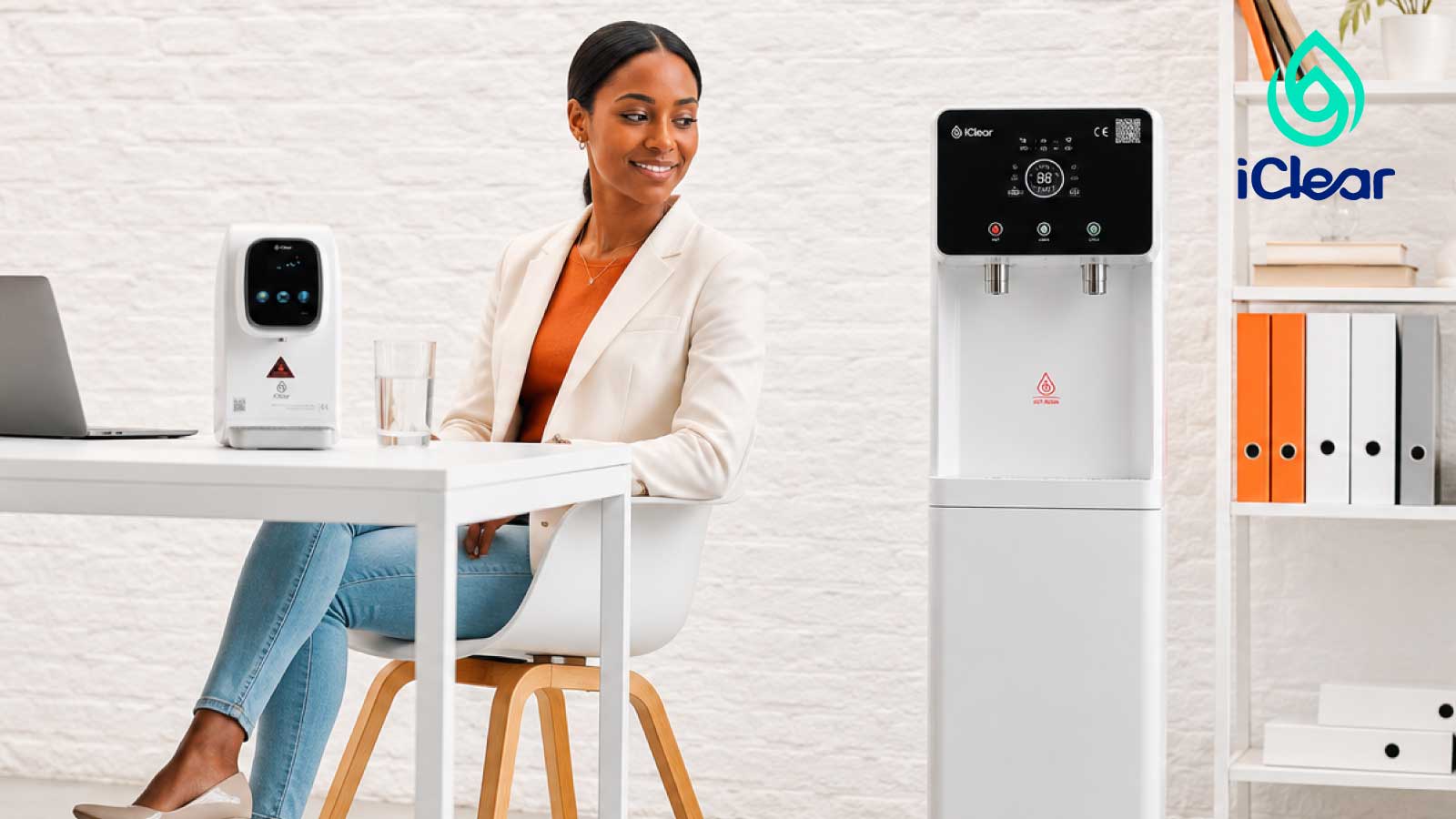
Quick Answer A water purifier dispenser is a single machine that both purifies water and dispenses it at your chosen temperature. It is different from an ordinary dispenser, which only stores and serves water without cleaning it. In Kenya, the iClear Desktop (KSh 40,000) is a countertop purifier dispenser with full Reverse Osmosis and instant hot water in 3 seconds, and the iClear Office system (KSh 90,000 per year) is a bottleless purifier dispenser serving 20 to 30 staff hot and cold purified water on demand. Purifier dispenser vs ordinary dispenser: the difference that matters The two machines look similar on a counter. What happens inside them is completely different. An ordinary dispenser holds a bottle or tank of water and changes its temperature. Whatever contaminants are in the water pass straight through to your glass. A purifier dispenser puts the water through genuine purification, in iClear's case multi-stage Reverse Osmosis, before it ever reaches the tap. Capability Ordinary dispenser Purifier dispenser (iClear) Hot and cold serving Yes Yes Removes bacteria and viruses No Yes Removes fluoride No Yes Removes dissolved salts (TDS) No Yes Needs bottled water deliveries Yes No Reservoir hygiene risk High if uncleaned No stored reservoir to contaminate Key Finding: Studies of office water dispensers have found bacterial contamination, including coliforms, in units that passed visual inspection as clean. The reservoir, spigots, and drip tray of a conventional dispenser are contamination points a purifier dispenser simply does not have. The two purifier dispensers iClear makes iClear Desktop: the home and small office purifier dispenser Refilling the Desktop's removable 4-litre tank: no plumbing, no installation, purified water anywhere with a socket. Price KSh 40,000 (free delivery, Nairobi and Nakuru) Purification Full multi-stage Reverse Osmosis Dispensing Instant hot water in 3 seconds, six temperature settings, cold and ambient Setup No plumbing; built-in 4-litre tank; plug and use Best for Homes, apartments, renters, small offices of 1 to 3 regular users The Desktop replaces three appliances at once: the dispenser, the kettle, and the filter. Water is purified through RO, then heated to your selected temperature on demand, suited for tea, coffee, baby formula, or chilled drinking. iClear Office: the workplace purifier dispenser The iClear Office purifier dispenser: bottleless, floor-standing, with hot, lock, and cold controls. Price KSh 90,000 per year (annual agreement) Purification Bottleless RO plus UV Dispensing Unlimited hot and cold, safety lock on hot tap Servicing Free professional servicing every four months, included Best for Offices of 20 to 30 staff replacing bottled cooler setups The Office system connects directly to your water supply, which removes bottles, deliveries, storage, and the hygiene risks of bottle-fed coolers in one move. For a typical office spending KSh 12,000 to 20,000 per month on bottled water, the agreement usually costs less than the bottles it replaces. Who should buy a purifier dispenser instead of separate machines Households that boil water daily for tea, formula, or drinking: the Desktop collapses that routine into a 3-second dispense of already-purified hot water. Renters who cannot install plumbed systems but want genuine purification with dispensing convenience. Offices running bottled coolers: a purifier dispenser removes the recurring cost and the reservoir hygiene problem simultaneously. Anyone comparing a dispenser and a purifier as separate purchases: the combined machine is usually cheaper than buying both and eliminates the unpurified-dispenser risk entirely. FAQ Q: What is a water purifier dispenser? A: A single machine that purifies water and dispenses it at selected temperatures. Unlike an ordinary dispenser, which only stores and serves water, a purifier dispenser removes contaminants first. The iClear Desktop uses full Reverse Osmosis before dispensing hot, ambient, or cold water. Q: How much does a water purifier dispenser cost in Kenya? A: The iClear Desktop costs KSh 40,000 with free delivery in Nairobi and Nakuru. For offices, the iClear Office purifier dispenser is KSh 90,000 per year including installation and servicing every four months. Q: Does a purifier dispenser need plumbing? A: The iClear Desktop does not: it has a built-in 4-litre tank you fill manually, so it works anywhere with a power socket. The iClear Office system connects to your supply line and is professionally installed free in Nairobi, its environs, and Nakuru. Get one machine that purifies and dispenses. Free delivery and professional installation in Nairobi and Nakuru. Visit the iClear shop. Keywords: water purifier dispenser, water purifier and dispenser, hot water dispenser Kenya, water dispenser purifier, iClear Desktop, iClear Kenya, purifier dispenser for home
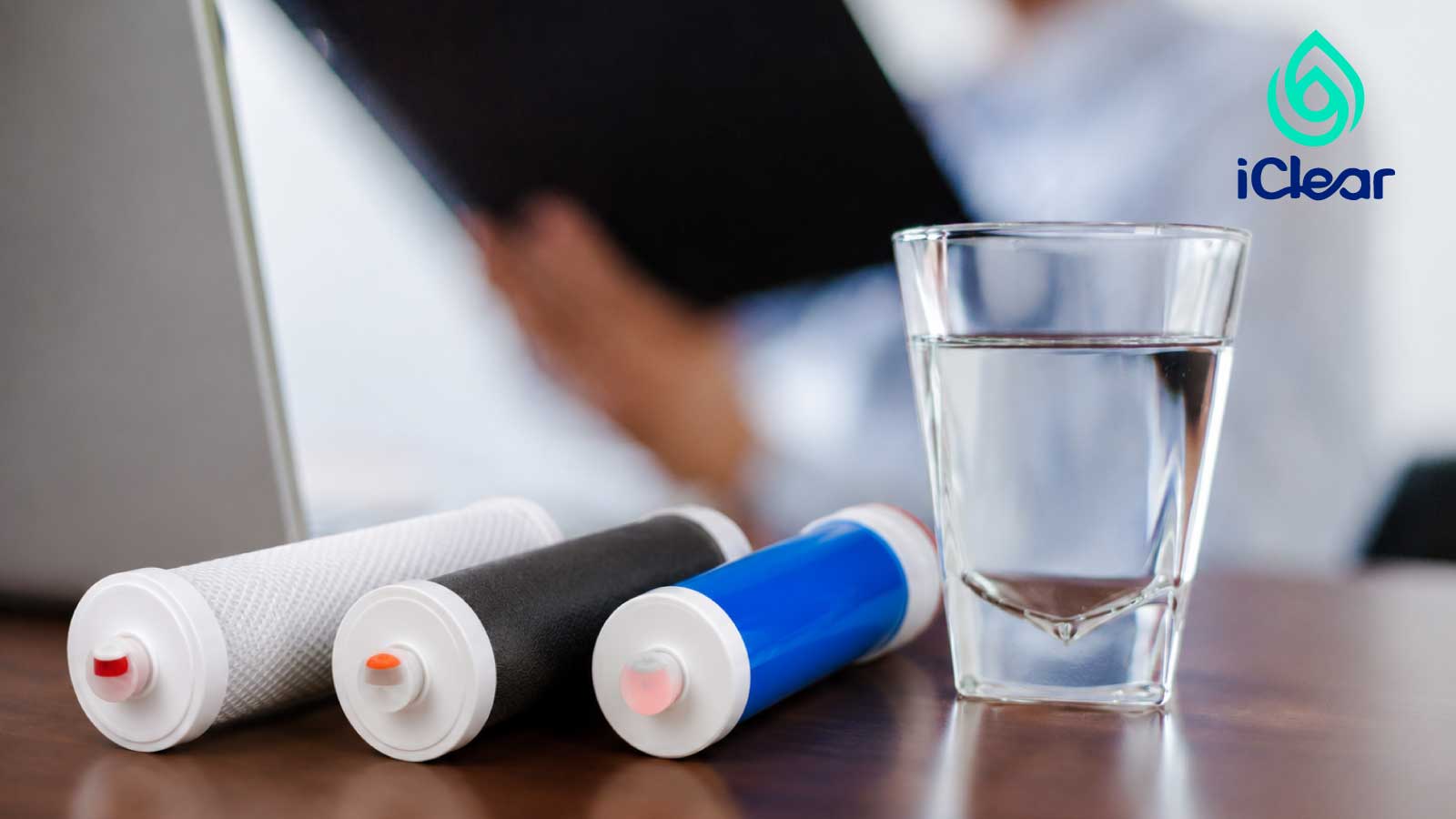
Quick Answer Reverse Osmosis (RO) purifies water by forcing it through a membrane whose pores are small enough to block dissolved salts, fluoride, heavy metals, bacteria, and viruses, while letting water molecules through. It is the only widely available technology that removes the full range of contaminants found in Kenyan water, and it typically reduces TDS by 90% or more. You need it if your home uses borehole, salty, or high-fluoride water. You may not need it if your municipal water is already low-TDS and you only want better taste. How Reverse Osmosis actually works Every RO system does the same core job in stages: Stage 1, pre-filtration: sediment and carbon filters remove particles, rust, and chlorine. This protects the membrane and handles the visible part of the problem. Stage 2, the RO membrane: water is pushed under pressure through a semi-permeable membrane with pores measured in fractions of a nanometre. Dissolved salts, fluoride ions, heavy metals, bacteria, and viruses are physically too large to pass. They are flushed away as reject water. Stage 3, post-filtration and storage: a polishing filter refines taste, and in plumbed systems, a pressure tank stores purified water so it is instantly available at the tap. The stages made visible: the iClear Standard's labelled P/C composite pre-filter, RO membrane, and CTO post-carbon filter. The critical distinction from every other filter type is that RO works at the molecular level. Carbon, ceramic, and UV all operate above it, which is why they cannot remove anything dissolved. Why RO matters more in Kenya than almost anywhere The case for RO in Kenya is not theoretical. It is in the measurements iClear's field team takes every week: Key Finding: Our highest fluoride reading in Rift Valley borehole water exceeded 8.75 mg/L, more than 5 times the WHO safe limit of 1.5 mg/L. Naivasha, Nakuru, Kajiado, Gilgil, and Kitengela all show consistently elevated fluoride. No amount of boiling, carbon filtering, or UV treatment reduces it. Only RO does. Figure 1: iClear's highest field fluoride measurement against the WHO safe limit. The same is true of dissolved salts. Borehole TDS in our field tests runs from 150 ppm in Karen to 600 ppm in Kitengela and Kajiado. Boiling concentrates these contaminants rather than removing them, because the water evaporates and the dissolved load stays behind. Boiling kills bacteria but makes dissolved contamination worse: as water boils off, fluoride and salts become more concentrated in what remains. For borehole households, boiling is not a safety strategy. It is a false comfort. What RO removes, by the numbers Contaminant Typical Kenyan source Boiling Carbon UV Reverse Osmosis Bacteria & viruses Storage tanks, supply Yes Partial Yes Yes Fluoride Rift Valley geology No No No Yes Dissolved salts (TDS) Boreholes, coastal water No No No Yes Heavy metals Ageing pipes, geology No No No Yes Sediment & rust Tanks, old plumbing No Partial No Yes A well-installed RO system typically reduces TDS by 90% or more. A Kitengela borehole reading 600 ppm before treatment will commonly come out below 50 ppm after RO, which is the difference between water that strains the body over time and water that is genuinely pure. When you actually need RO, and when you do not You need RO if: your water comes from a borehole anywhere in Kenya; your water tastes salty or mineral-heavy; you live in or near a known high-fluoride area (Naivasha, Nakuru, Kajiado, Gilgil, Kitengela); or your household includes children, whose developing teeth and bones absorb fluoride fastest. You may not need RO if: your municipal supply tests consistently low-TDS, your storage tank is professionally maintained, and your only complaint is chlorine taste. In that narrow case, a quality carbon filter improves taste for less. Most Kenyan homes are not in that case. What an iClear RO system includes Every iClear system is a full multi-stage RO purifier, KEBS-certified, with free delivery and professional installation in Nairobi, its environs, and Nakuru. The Standard (KSh 25,000) suits everyday households, the Premier (KSh 49,000) delivers 7,200 litres per day for households of 8 to 15, the Desktop (KSh 40,000) provides portable RO with instant hot water for renters, and the Office system (KSh 90,000 per year) serves 20 to 30 staff with servicing included every four months. A standard home installation takes 30 to 45 minutes. FAQ Q: What does reverse osmosis remove from water? A: Dissolved salts, fluoride, heavy metals (including lead and arsenic), nitrates, bacteria, viruses, and sediment. In iClear installations, RO typically reduces TDS by 90% or more, taking a 600 ppm borehole reading below 50 ppm. Q: Does reverse osmosis remove fluoride? A: Yes, and it is the only common household technology that does. Fluoride ions cannot pass the RO membrane. This matters acutely in Kenya, where iClear has measured borehole fluoride above 8.75 mg/L against a WHO limit of 1.5 mg/L. Q: Is RO water safe to drink every day? A: Yes. RO water is purified water. It contains dramatically fewer dissolved minerals than untreated water, and a normal diet supplies the minerals the body needs. For high-fluoride and high-TDS areas of Kenya, daily RO water is not just safe but protective. Q: How much does a reverse osmosis machine cost in Kenya? A: iClear's 2026 RO range runs from KSh 25,000 (Standard) to KSh 49,000 (Premier) for homes, KSh 40,000 for the portable Desktop, and KSh 90,000 per year for the Office system, all including free delivery and professional installation in Nairobi and Nakuru. Get Reverse Osmosis built for Kenyan water. Free delivery and professional installation in Nairobi and Nakuru. Visit the iClear shop. Keywords: reverse osmosis water treatment, reverse osmosis Kenya, ro water purifier, reverse osmosis water filter, RO system Kenya, iClear Kenya, fluoride removal Kenya
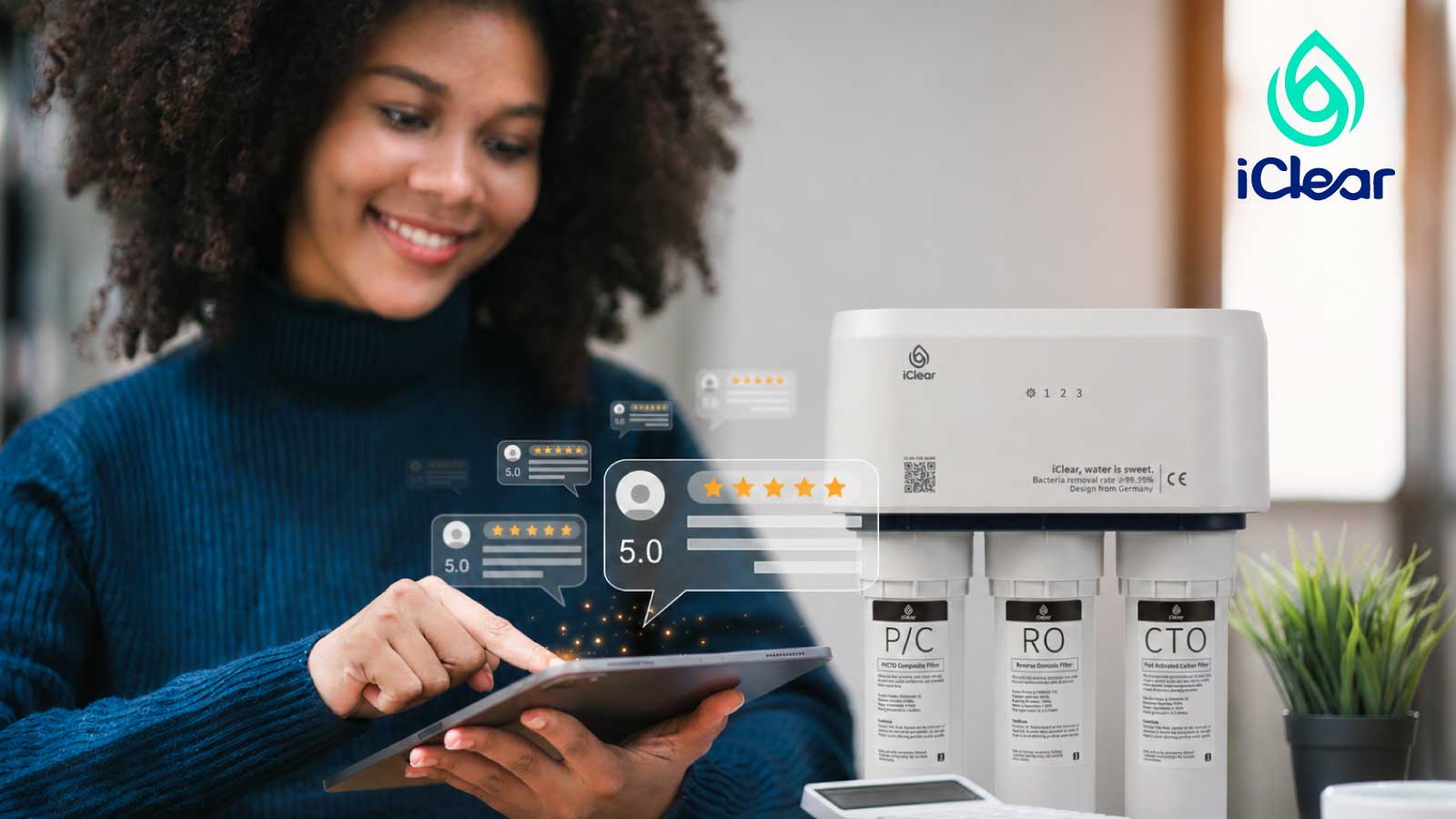
Quick Summary Across four years and more than 12,000 families served in 5+ countries, the most consistent things iClear customers report are: an immediate difference in taste, shock at what the first filter reveals about their old water, and one recurring sentiment: they wish they had switched sooner. Below are real customer words, what drives them, and the honest picture of who iClear is and is not for. What customers say about the water "Since I installed the iClear purifier in my home, we now feel the difference in taste as a lot of impurities are removed and we can drink water directly from the tap." iClear customer review, iclear.co.ke "This thing has changed my life." iClear customer review, iclear.co.ke Taste is the first thing customers notice, usually within the first glass. The reason is measurable: Reverse Osmosis typically cuts TDS by 90% or more, and in the towns where iClear works, the starting readings run from 150 ppm in Karen to 600 ppm in Kitengela and Kajiado boreholes. Removing that dissolved load changes how water tastes in a way customers describe without prompting. "My water tastes funny" usually traces to elevated TDS or chlorine residues. "My borehole water is too salty" matches the 450 to 600 ppm readings common in Kitengela and Kajiado. "I want safe drinking water for my family" is the most common reason of all, and the one the field data most strongly supports: our team has measured fluoride above 8.75 mg/L in Rift Valley boreholes, more than five times the WHO safe limit. Key Finding: The biggest referral engine in iClear's four years has not been advertising. It is neighbours: "My neighbour saw the system and wanted one too" is a recurring line from new customers, and young families, borehole-estate tenants, landlords, offices, and dental clinics make up the core customer base. The honest picture: who iClear is and is not for iClear is for you if: your home runs on borehole, salty, or uncertain municipal water; you want certified purification with installation handled; or your office wants to eliminate bottled water. The Standard, Premier, Desktop, and Office system cover those cases at KSh 25,000 to KSh 90,000. Look elsewhere if: you only want a cheap taste improvement on already-clean municipal water (a basic carbon jug does that for less), you live outside iClear's free installation zone and prefer a local installer, or you are building a water vending business, which commercial equipment providers serve better. FAQ Q: Are iClear water purifiers good? A: Customer feedback centres on three things: a clear taste difference from day one, fast and free professional installation (30 to 45 minutes in Nairobi and Nakuru), and reliable after-sales support. Every product is KEBS-certified, and iClear serves over 12,000 families across 5+ countries after four years of operation. Q: Where can I read iClear reviews? A: Customer testimonials are published on iclear.co.ke, and this page collects representative reviews alongside the recurring feedback themes iClear's field team records during installations. Q: What do customers complain about? A: The most common pre-purchase concerns are cost, maintenance, electricity use, and filter replacement costs. Post-installation, the recurring sentiment is not a complaint but a regret: that they waited years longer than they needed to. Join 12,000+ families drinking genuinely clean water. Free delivery and professional installation in Nairobi and Nakuru. Visit the iClear shop. Keywords: iclear water reviews, iClear reviews Kenya, iClear water purifier reviews, iClear Kenya, water purifier reviews Kenya, iClear customer feedback
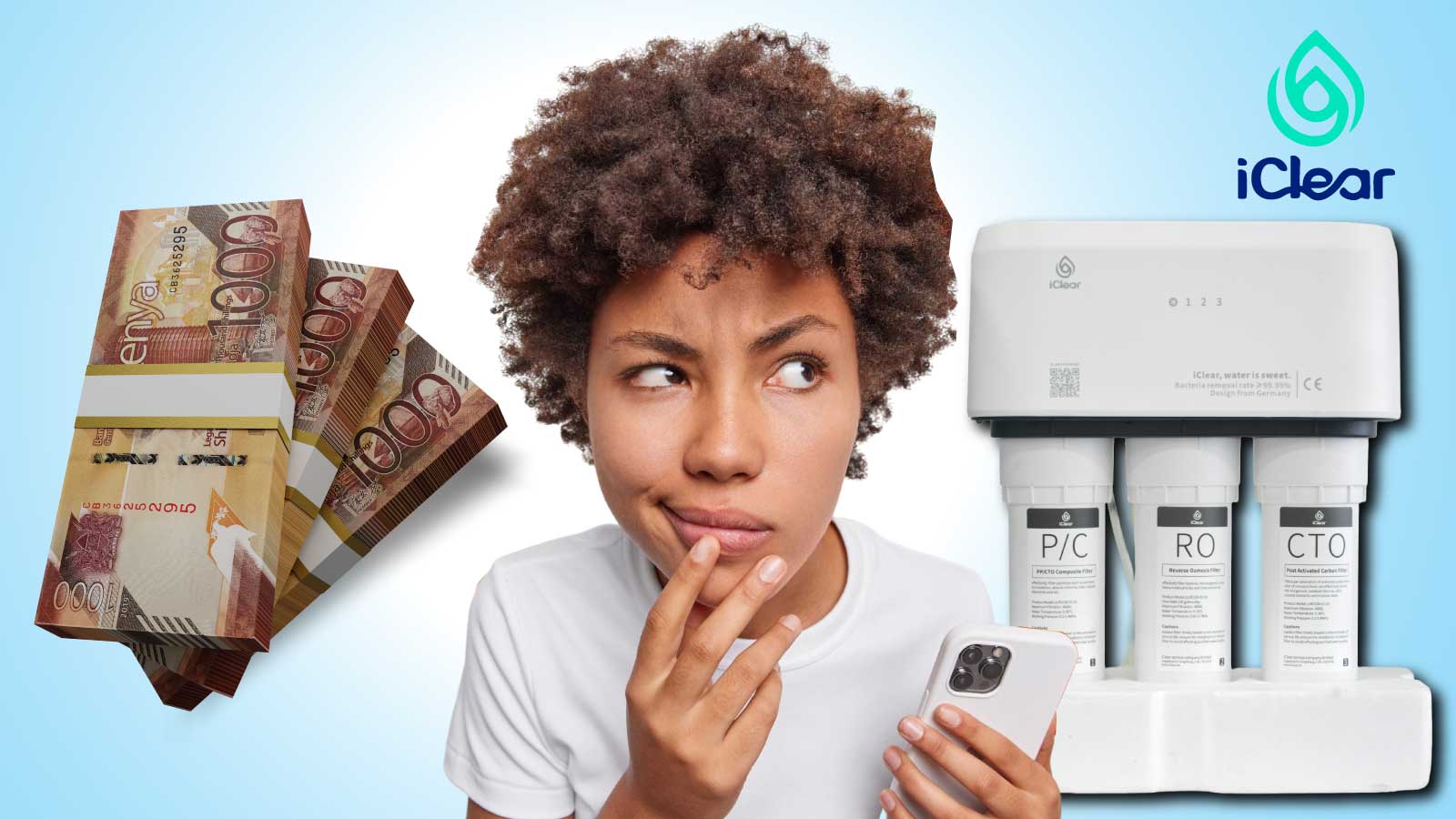
Quick Answer: What Water Purifiers Cost in Kenya Genuine Reverse Osmosis water purifiers in Kenya range from KSh 25,000 to KSh 90,000 depending on capacity and use case. iClear's current 2026 prices: Standard KSh 25,000, Desktop KSh 40,000, Premier KSh 49,000, and the Office system at KSh 90,000 per year on an annual agreement. Every iClear price includes free delivery and professional installation in Nairobi and Nakuru, plus a 1-year warranty. 2026 price list: what each system costs and includes System Price (KSh) Best for What is included iClear Standard 25,000 Everyday households; borehole, salty, municipal water Full RO system, pressure tank, free delivery + installation, 1-yr warranty iClear Desktop 40,000 Renters, apartments, small offices; no plumbing Portable RO, instant hot water (6 settings), 4L tank, free delivery iClear Premier 49,000 Households of 8 to 15; small offices High-capacity RO (7,200 L/day), pressure tank, free delivery + installation, 1-yr warranty iClear Office 90,000 / year Offices of 20 to 30 staff Bottleless RO + UV, hot & cold, free installation, free servicing every 4 months Prices verified from iclear.co.ke in July 2026. Confirm current pricing on the shop page before purchase, as promotions run periodically. The iClear Desktop (KSh 40,000) with its removable 4-litre tank: portable RO with no plumbing required. What drives the price differences The spread from KSh 25,000 to KSh 90,000 is not branding. Each step up buys a specific capability: Capacity: the Premier's 100 gallon (7,200 litre) daily output roughly doubles the throughput of the Standard, which is why it serves households of 8 to 15 people. Features: the Desktop adds instant heating with six temperature settings and full portability, replacing both a purifier and a kettle. Service model: the Office system's annual price includes professional servicing every four months, converting maintenance from your problem into part of the agreement. Key Finding: Across the Kenyan market, the single largest hidden cost is installation. Many brands quote a machine price that excludes it. Every iClear price above includes professional installation by iClear technicians in Nairobi, its environs, and Nakuru, which no other water purifier brand in Kenya currently offers as standard. The real comparison: what you are already spending The most useful way to judge a purifier's price is against what a household spends without one. A typical Kenyan family buying bottled water spends KSh 3,000 to 8,000 per month, which is KSh 36,000 to 96,000 every year. Over five years, that is between KSh 180,000 and KSh 480,000 spent on water, against a one-time KSh 25,000 for an iClear Standard. Figure 1: Cumulative 5-year spend on bottled water versus a one-time iClear Standard purchase. On these numbers, the Standard pays for itself in roughly 4 to 8 months of bottled water savings, and iClear's own estimate is that customers save up to 80% compared to bottled water. Filter replacements add a modest ongoing cost, scheduled and supported by iClear's service team, but the overall picture does not change: for most households, the purifier is not an expense. It is the cheaper option. Price traps to avoid A low machine price with installation excluded: get the total installed cost in writing before comparing. Uncertified units at attractive prices: a system that does not remove what it claims is wasted money at any price. Ask for KEBS certification documentation. No after-sales structure: replacement filters that are hard to source or unpriced at purchase become expensive later. Marketplace listings without support: the price may be real, but installation, warranty handling, and servicing land entirely on you. FAQ Q: How much does a water purifier cost in Kenya? A: Genuine RO water purifiers cost from KSh 25,000 to KSh 90,000 in 2026. iClear's range: Standard KSh 25,000, Desktop KSh 40,000, Premier KSh 49,000, and the Office system at KSh 90,000 per year including quarterly servicing. All include free delivery and professional installation in Nairobi and Nakuru. Q: Is an RO system worth the price? A: For most households, yes, on the maths alone. A family spending KSh 3,000 to 8,000 monthly on bottled water spends KSh 36,000 to 96,000 a year. A KSh 25,000 iClear Standard typically pays for itself within 4 to 8 months, then keeps saving every month after. Q: What does installation cost? A: With iClear, nothing. Free professional installation in Nairobi, its environs, and Nakuru is included with every purchase, and a standard home install takes 30 to 45 minutes. With other providers, always confirm whether installation is included before comparing prices. Q: Are there ongoing costs after buying? A: Yes: filters need scheduled replacement to keep any RO system performing. iClear schedules and supports replacements across its range, and the Office agreement includes free servicing every four months. See current prices and choose your system. Free delivery and professional installation in Nairobi and Nakuru. Visit the iClear shop. Keywords: water purifier price in kenya, water filter price in kenya, water purification machine price in kenya, reverse osmosis machine price in kenya, iClear prices, water purifier Kenya
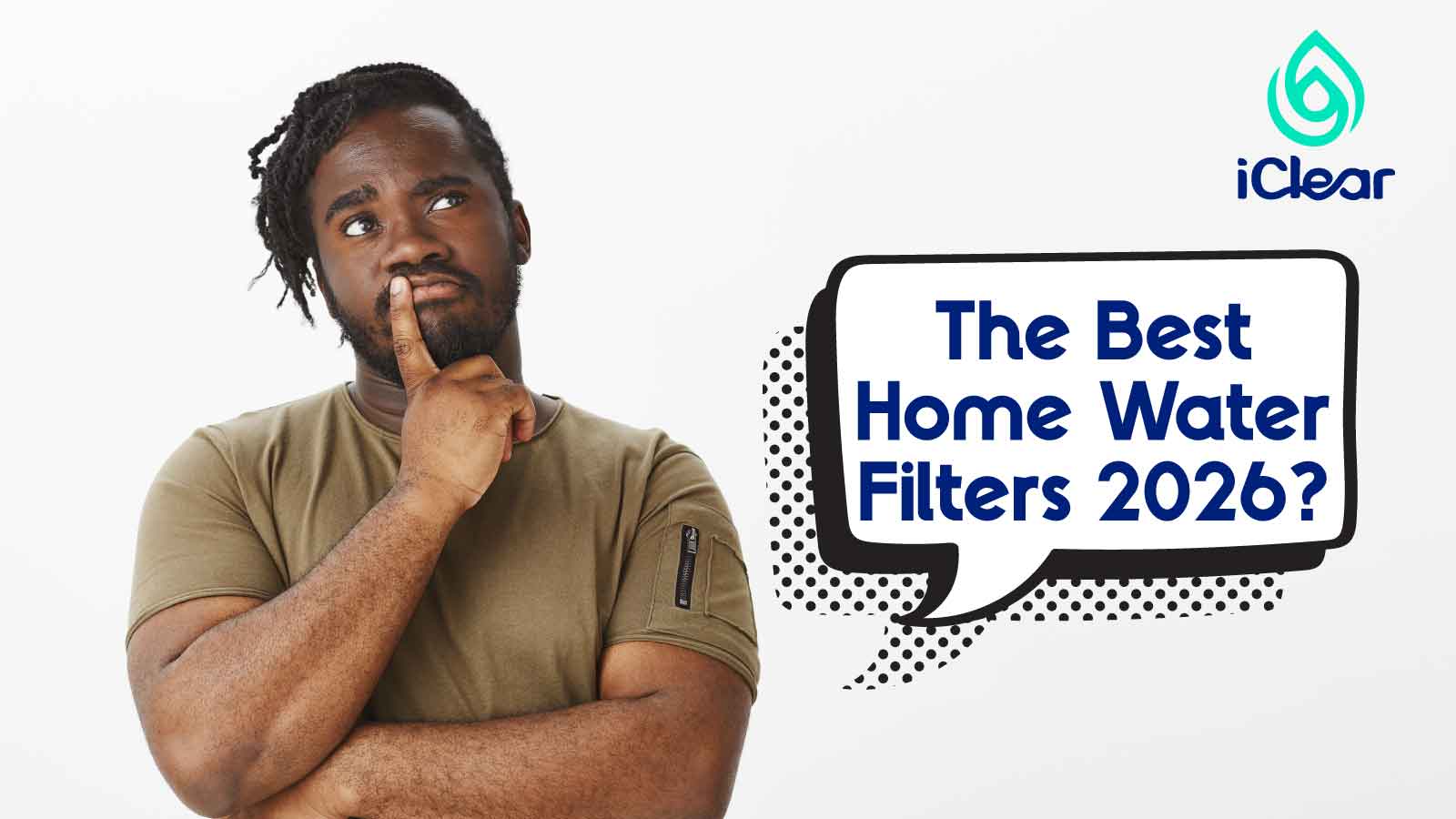
Quick Answer For most Kenyan homes: a KEBS-certified Reverse Osmosis system is the only filter type that removes fluoride, dissolved salts, heavy metals, and bacteria together. Our field team has measured fluoride above 8.75 mg/L in Rift Valley boreholes, which no carbon, ceramic, or UV filter can touch. Best for homeowners: iClear Standard (KSh 25,000, installation included). Best for large households: iClear Premier (KSh 49,000, 6 to 10 people). Best for renters: iClear Desktop (KSh 40,000, no plumbing). How we evaluate water filters iClear's technical team installs and tests water purification systems across Kenya every week, measuring TDS before and after installation with calibrated meters and recording water conditions town by town. Our evaluation of any water filter rests on six criteria: the filtration technology, certification, installation, capacity, after-sales support, and fit for the household's living situation. Key Finding: Across our 2026 field tests, borehole TDS ranged from 150 ppm in Karen to 600 ppm in Kitengela and Kajiado, and our highest fluoride reading exceeded 8.75 mg/L against a WHO safe limit of 1.5 mg/L. A home water filter in Kenya has to be judged against these real conditions, not laboratory ideals. Figure 1: Typical TDS readings from iClear field tests across five Kenyan towns, 2026. Why technology is the first filter Most disappointing water filter purchases in Kenya come down to one mismatch: the technology inside the filter cannot remove what is actually in the water. This chart summarises what each common technology handles. Figure 2: Removal capability by treatment technology. Only Reverse Osmosis covers all five contaminant categories. Boiling and UV kill microbes but leave every dissolved contaminant behind. Carbon improves taste. Ceramic handles sediment and bacteria. Only Reverse Osmosis removes the fluoride and dissolved salts that our field data shows are the defining problems in Kenyan water. For any home on borehole water, RO is the starting requirement, not a premium option. The 3 best home water filter options in Kenya 1. iClear Standard: best overall for Kenyan homes The iClear Standard from every angle: three-stage filter unit with wall-mount back plate. Price KSh 25,000 (free delivery and installation, Nairobi and Nakuru) Technology Multi-stage Reverse Osmosis Best for Everyday households on borehole, salty, rain, or municipal water Certification KEBS certified Warranty 1 year The iClear Standard is built specifically for the water conditions in our field data: salty boreholes, high-fluoride groundwater, and variable municipal supply. Professional installation by iClear technicians is included and takes 30 to 45 minutes. Choose it if: you own your home and want permanent purified water at the best price in the range. Skip it if: your household is above 8 people (see the Premier) or you rent and cannot modify plumbing (see the Desktop). 2. iClear Premier: best for large households The iClear Premier: high-capacity RO in a sealed, compact housing. Price KSh 49,000 (free delivery and installation, Nairobi and Nakuru) Technology High-capacity multi-stage RO Capacity 100 gallons (7,200 litres) per day Best for Households of 6 to 10 people, small offices Certification KEBS certified Warranty 1 year Choose it if: your household is large or you run a small office. Skip it if: you are 1 to 4 people; the Standard covers you at half the price. 3. iClear Desktop: best for renters and small spaces The iClear Desktop's touchscreen: six one-touch temperature presets including Tea, Coffee, Milk, and Hot. Price KSh 40,000 (free delivery, Nairobi and Nakuru) Technology Portable RO with instant heating Features Hot water in 3 seconds, six temperature settings, 4-litre tank Best for Renters, apartments, small offices; no plumbing required Certification KEBS certified Choose it if: you rent, move often, or want instant hot purified water without any installation. Skip it if: your household consumes large volumes daily; the 4-litre tank suits 1 to 3 people best. The comparison at a glance Criterion iClear Equipment groups Importers Marketplace Focus Home & office drinking water Broad water & energy Imported home units Mixed brands RO technology All products Selected products Selected products Varies KEBS certification Yes, all products Check with provider Check with provider Varies by listing Free installation Yes, Nairobi & Nakuru Check with provider Check with provider Rarely Scheduled servicing Yes Check with provider Check with provider Buyer-managed FAQ Q: What is the best water filter for a home in Kenya? A: For most Kenyan homes, a KEBS-certified Reverse Osmosis system. Our field data shows fluoride up to 8.75 mg/L and TDS up to 600 ppm in common borehole sources, and RO is the only technology that removes both alongside bacteria and heavy metals. The iClear Standard (KSh 25,000, installation included) is the strongest overall fit for typical households. Q: Do I need RO, or is a carbon filter enough? A: If your water is municipal, low-TDS, and you only want better taste, carbon helps. If your home uses borehole water anywhere in Kenya, carbon is not enough: it removes neither fluoride nor dissolved salts. Our town-by-town readings (Figure 1) show why RO is the baseline for borehole homes. Q: What does KEBS certification mean on a water filter? A: It means the Kenya Bureau of Standards has independently tested the product against national safety standards. It is the most reliable quality signal available to Kenyan buyers. Every iClear product carries it; always ask any other provider for their certification documentation. Q: How much should I expect to pay for a good home water filter in Kenya? A: Genuine home RO systems in Kenya start around KSh 25,000. iClear's home range runs from KSh 25,000 (Standard) to KSh 49,000 (Premier), with free delivery and professional installation included in Nairobi and Nakuru. Get the right filter for your water, verified by field data. Free delivery and professional installation in Nairobi and Nakuru. Visit the iClear shop. Keywords: best home water filters, best water filter Kenya, water filter Kenya, water purifier Kenya, Reverse Osmosis Kenya, KEBS certified water purifier, iClear Kenya
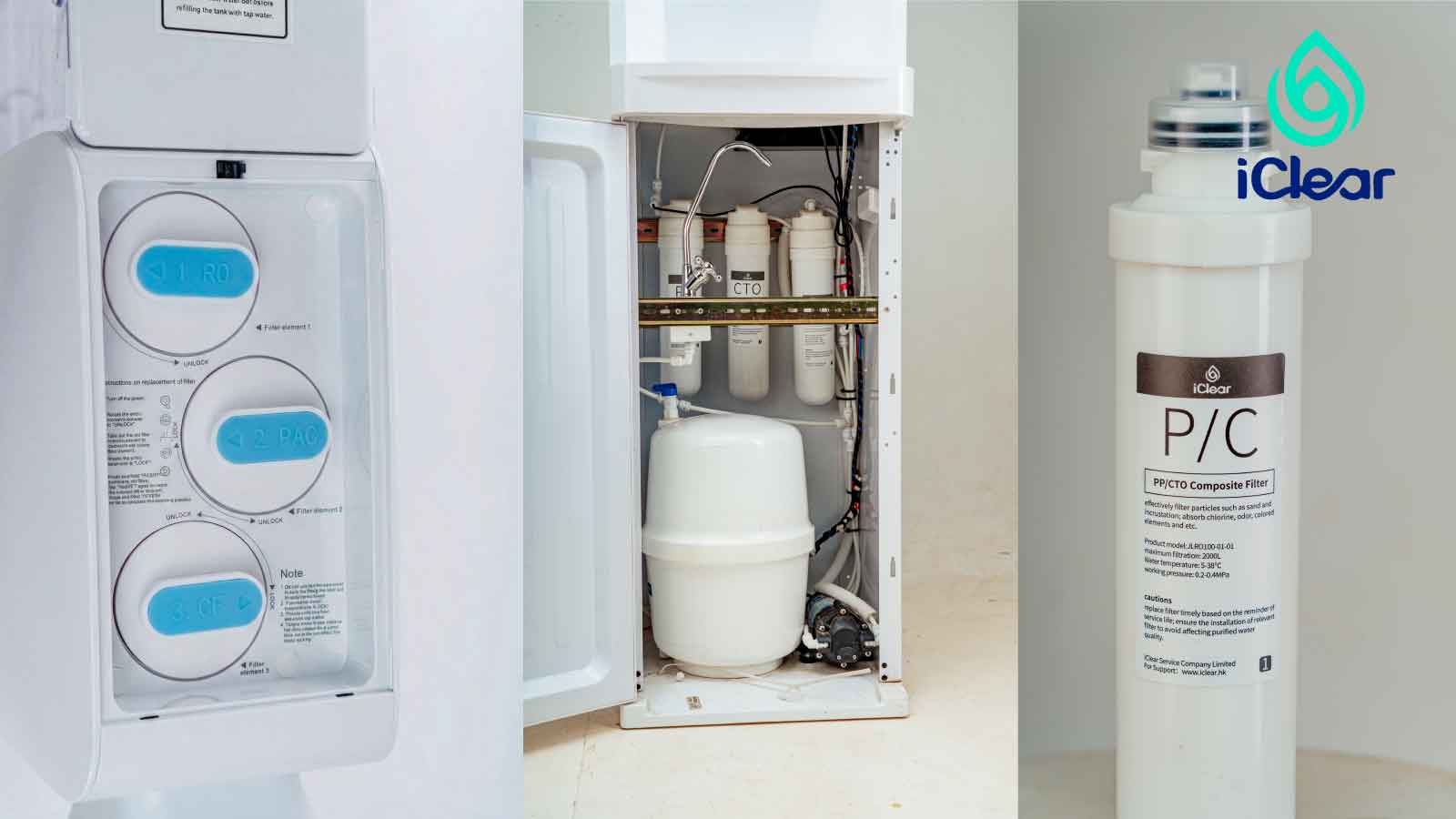
When iClear replaces an old water filter, the moment of opening it up is often the most powerful part of the installation. What comes out tells you exactly what has been getting trapped, or worse, missed, by the system the household has been trusting for years. Here are the five things our team finds, again and again, inside Kenyan water filters that have not been properly maintained. 1. Excess sediment The first thing that hits you when you open most old filters is sediment. Fine, settled, sometimes thick layers of suspended material that has built up across months or years of use. This sediment was passing through the household water supply, getting partially captured by the filter, and being held there as the rest continued through. As the filter saturated, more and more of it began passing straight through to the drinking water. 2. Rust particles Rust is one of the most visually striking discoveries when an old filter is opened. Reddish-brown particles, sometimes flakes, sometimes a fine powder, embedded throughout the filter media. The rust typically comes from aged pipes, older storage tanks, or corroded fittings between the supply and the filter itself. Rust in your drinking water is not just an aesthetic problem. Sustained iron consumption beyond healthy levels strains the liver and can cause gastrointestinal effects, and the corrosion that produces the rust often indicates broader infrastructure issues in the home's water system. 3. Sand and silt buildup In homes that rely on borehole water, sand and silt are common arrivals. They originate from the borehole itself, from older pumps and casings, and from the surrounding geology. Standard filters trap them effectively, but they accumulate quickly. Without timely replacement, the filter becomes a reservoir of trapped silt rather than an active filtration stage. In homes on municipal supply, silt usually arrives via ageing pipes. Either way, what was meant to be removed is sitting inside the filter, slowly clogging the flow path and reducing performance. 4. Expired cartridges left unchanged for years This is the most damaging finding of the five. Filter cartridges have defined operational lifespans, typically measured in months or, at most, a year for most filter types. Once that lifespan is exceeded, the cartridge stops working as a filter and, in some cases, becomes a contamination source itself. The trapped material starts to break down, bacteria can grow on saturated media, and what was once a barrier becomes a passage. Many of the old filters our team opens have cartridges that have been left unchanged for two, three, or even five years. The customers were unaware. They had assumed the system was still working because water was still coming out. 5. Visible biological growth In warm, damp filter housings that have not been serviced, biological growth eventually starts. Mould around seals, algae in clear housings exposed to light, biofilm on saturated media. None of this is visible from outside the system, and most homeowners would never know without opening it. Once present, it represents a continuous low-level contamination source in every glass of water that passes through. Why this matters for any filter, not just old ones These findings are not specific to bad filters. They are what happens to any filter, including good ones, that is not properly maintained. The difference between a filter that is helping your family and a filter that is harming them is often as simple as scheduled replacement of cartridges and consistent servicing. Across the iClear range, part of what comes with every purchase is ongoing maintenance support. Filter replacements are scheduled and communicated. For the iClear Office system, professional servicing every four months is included as part of the annual agreement. The goal is to make sure no iClear customer ever opens a filter five years later and finds what we have found in some of the systems we replace. Every old filter we open tells the same story: a household that thought it was protected, was actually consuming partially filtered water, and had no idea. The lesson is not that filters do not work. It is that filters only work when they are maintained. Choose a system, and a service, that does not leave the maintenance to chance. Replace your old filter with a properly serviced iClear system. Free delivery and professional installation in Nairobi and Nakuru. Visit the iClear shop. Keywords: old water filter Kenya, replace water filter Kenya, water filter maintenance, water purifier service Kenya, iClear Kenya, water filter replacement
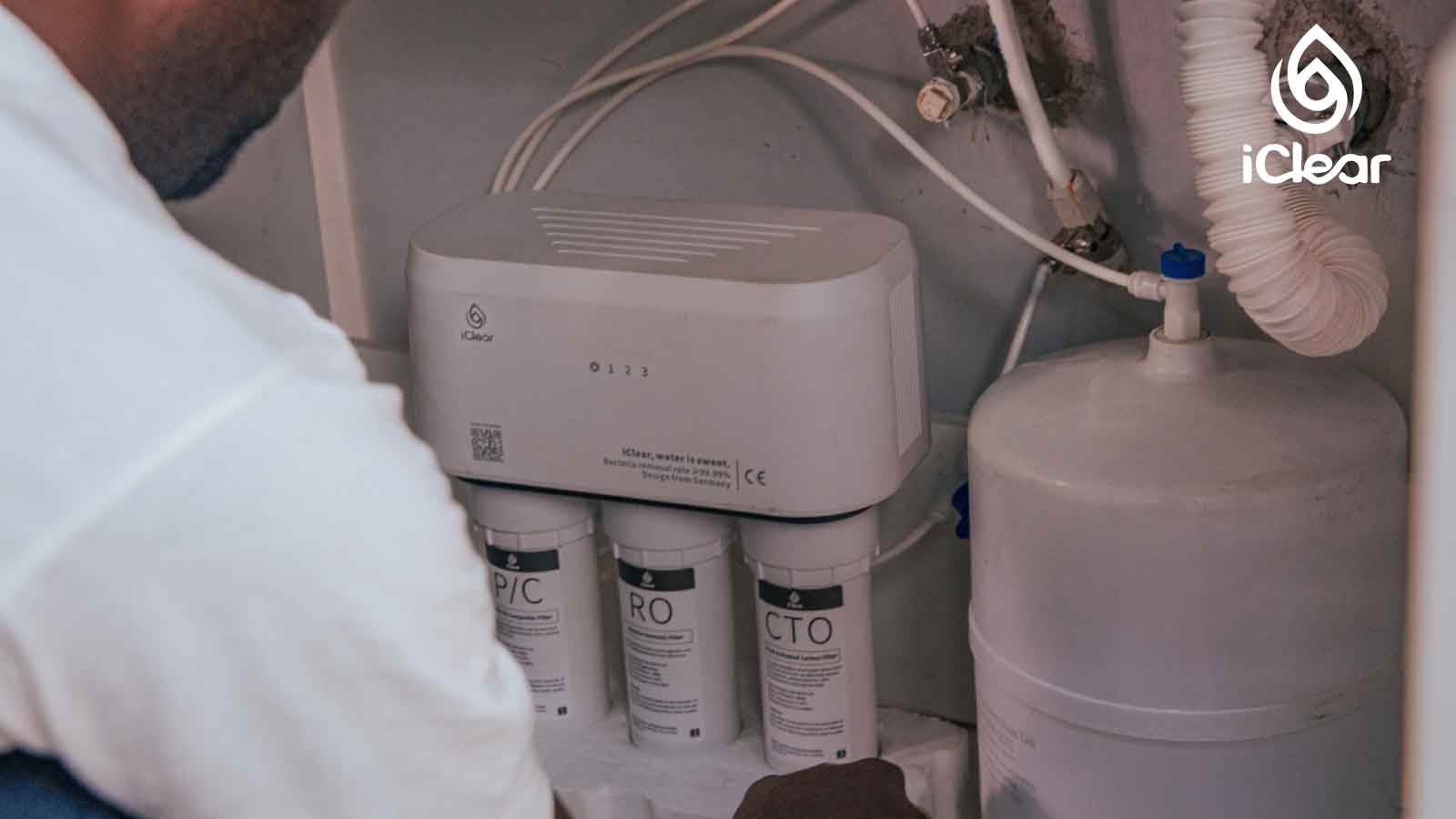
One of the most common questions iClear's team gets before a sale is some version of: "How disruptive is the installation?" The honest answer surprises most customers. A typical home installation takes between 30 and 45 minutes. Here is exactly what happens during that visit, step by step, so you know what to expect. Before the technician arrives Our sales team agrees an installation window with you ahead of time and confirms the day before. Our technicians arrive with the complete system, all necessary fittings, and the tools required for a standard installation. You do not need to buy anything in advance or prepare any specific tools or materials. What helps is having a clear space near where the system will be installed, ensuring there is a power socket nearby for the system to plug into, and making sure your storage tank is full or your supply is on, so we can test the system before we leave. The first ten minutes: assessment The technician walks through the installation site with you and checks four things before touching anything: The water source, whether you are on municipal supply, a borehole, a tank, or a mix The available electric socket and its position relative to the install location The available installation space, especially under the sink for plumbed systems The condition of the inlet plumbing, looking for leaks, age, or pressure issues This assessment usually catches existing issues you may not be aware of: a leaky connection, an old shut-off valve, a storage tank that needs attention. Where we spot something, we tell you. We do not fix unrelated plumbing problems as part of the install, but flagging them gives you the option to address them separately. The single most common cause of an installation running longer than 45 minutes is unexpected plumbing modifications or inaccessible pipework. Most of the time, the assessment phase catches this early. The next twenty to thirty minutes: installation Once the assessment is done, the actual installation is methodical. For a plumbed system like the iClear Standard or iClear Premier, the technician: Connects the system to your water inlet Mounts the unit in the agreed location, usually under the sink or in a utility cupboard Installs the dedicated dispensing tap on your counter or sink Connects to the pressure storage tank Connects to the electric socket Flushes the system to clear it of any installation debris Tests pressure, flow, and seal integrity For the iClear Desktop, the process is dramatically shorter. The unit plugs in, the tank is filled, and the system is ready. Most Desktop installations are complete in under fifteen minutes. The final five minutes: handover Before leaving, the technician walks you through the basics: How to operate the system day to day How often you can expect filter replacements (and that we contact you when it is time) How to reach iClear's support team for any questions or issues What to expect in the first 24 hours, including running the first batch of water through You receive your warranty documentation and contact details for the iClear support team. The technician confirms that everything is working, leaves the install site clean, and you start using your new water purifier. Why professional installation matters Customers who try to install RO systems themselves, or who hire general plumbers unfamiliar with water purification, frequently end up with problems that compromise performance: bypassed filtration stages, incorrect inlet pressure, leaks at unfamiliar fittings, or damaged membranes from improper handling. These issues are not always immediately obvious, which makes them harder to spot later. iClear's installations are carried out by technicians who have done hundreds of similar setups. Every iClear purchase includes free professional installation in Nairobi, its environs, and Nakuru. No other water purifier brand in Kenya currently offers this as standard. The 30-to-45-minute install you get is the same install every other iClear household and office in your area has received. Installation day is the shortest, least disruptive part of owning an iClear system. Thirty to forty-five minutes from the moment the technician arrives to your first glass of genuinely purified water. No mess, no major plumbing changes, no surprises. Schedule your iClear installation today. Free delivery and professional installation in Nairobi and Nakuru. Visit the iClear shop. Keywords: iClear installation, water purifier installation Kenya, RO water purifier installation, iClear Kenya, water purifier installation Nairobi, professional water purifier installation
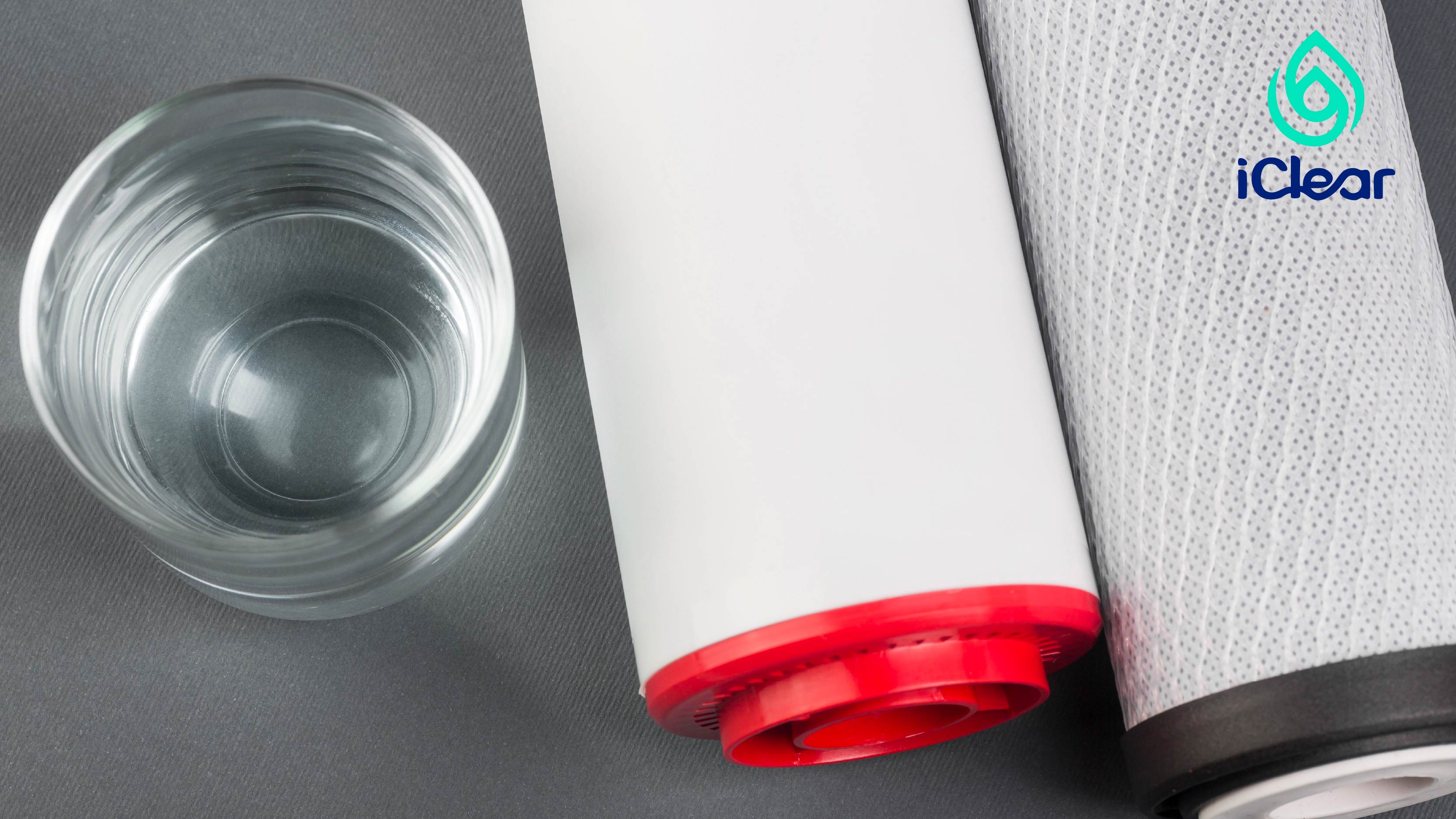
The term Reverse Osmosis sounds technical. The technology behind it is genuinely sophisticated. But the basic idea is simple enough that any family considering an RO system can understand exactly what they are buying and why it works. Reverse Osmosis, or RO, is a water purification process that forces water through an extremely fine membrane. The membrane has pores so small that water molecules can pass through, but almost everything else cannot. That includes fluoride, heavy metals, salts, bacteria, viruses, and the dissolved contaminants that boiling and standard filters fail to remove. The basic process, in plain terms A typical RO system in a Kenyan home runs water through several stages. First, a sediment filter catches visible debris like sand and rust. Second, an activated carbon filter removes chlorine and improves taste. Third, the water hits the RO membrane itself, which is where the real purification happens. Fourth, a post-filter polishes the water before it reaches your glass. Each stage handles something different. Together, they produce water that is genuinely clean: no fluoride, no heavy metals, no salts, no harmful microorganisms. The water that comes out is pure enough that it tastes noticeably different. Many first-time RO users describe it as the way water is supposed to taste. Why it matters for Kenyan water specifically Kenyan water carries a specific set of challenges. The fluoride in Rift Valley groundwater. The heavy metals from ageing Nairobi pipes. The salinity from Nairobi's eastern boreholes. The unpredictability of municipal supply quality. Most purification technologies handle one or two of these. RO handles all of them in a single process. That is why it has become the default for Kenyan households that want a permanent solution rather than a partial one. What RO does not do Worth being honest about the limits. RO produces some wastewater during the purification process. Older systems wasted a lot. Modern RO systems used by serious manufacturers have improved efficiency significantly, but there is still some waste. This is the trade-off for producing genuinely clean water. RO systems also need maintenance. Filters need replacing on a regular schedule. The membrane lasts longer but eventually needs servicing. A good supplier handles all of this with you as part of the package, so the homeowner does not have to think about it. How Kenyan households are using it RO is now the most widely installed certified household purification technology in Kenya. As featured in a recent Daily Nation article, more than 12,000 Kenyan homes, offices, schools, and clinics have already installed RO-based systems through iClear alone. The shift reflects a broader change in how Kenyan families think about water: not as something you boil and hope for the best, but as something you treat properly with the right technology. Choosing the right system for your home Three things matter when choosing an RO system. First, certification. KEBS certification confirms the system has been tested and meets Kenyan safety standards. Avoid uncertified units, no matter how cheap. Second, capacity. A small household needs a different size from a larger family or an office. Third, service. The system itself is only as good as the after-sales support behind it. Filters need changing. Membranes need attention. Pick a supplier who will be there for the long run. CALL TO ACTION Curious whether RO is right for your home? iClear's team will walk you through your options based on your water source and household size. WhatsApp to book a free consultation.
The water filter market in Kenya has grown rapidly, and with that growth has come confusion. Different technologies, wildly different prices, and competing claims make it hard to know what you are actually buying. This guide covers everything you need to know about water filters in Kenya before you spend a shilling. Why water filters have become essential in Kenya Kenya's water supply, whether municipal, borehole, or rainwater, rarely arrives at the tap genuinely safe to drink. Municipal water travels through ageing pipes that can reintroduce bacteria and heavy metals. Borehole water carries naturally occurring fluoride, nitrates, and salts. Even rainwater picks up contaminants from roofs, gutters, and storage tanks. A water filter is no longer a luxury in Kenya. For most households and offices, it is the most reliable way to ensure the water they drink every day is genuinely safe. The types of water filters available in Kenya Understanding the categories is the first step to making a good decision: Sediment and gravity filters: remove visible particles only Carbon filters: improve taste and remove chlorine, limited against chemicals and metals Ceramic filters: effective against sediment and some bacteria, slow and limited otherwise UV purifiers: kill bacteria and viruses but remove nothing dissolved Reverse Osmosis systems: comprehensive removal of bacteria, viruses, heavy metals, fluoride, nitrates, and dissolved salts What to check before buying any water filter in Kenya Does it match your water source? This is the single most important question. A filter that works for treated municipal water may be useless against borehole water high in fluoride and salts. Always start with what is in your water. Is it KEBS-certified? The Kenya Bureau of Standards certification is your assurance that the product has been independently tested and meets national safety standards. It is the clearest way to separate a verified product from an unverified one. What does it cost to run, not just to buy? The purchase price is only part of the cost. Filter replacements, maintenance, and installation all add up. A cheap filter with expensive or hard-to-find replacement parts can cost more over time than a quality system with proper support. Is installation included? Many filters in Kenya are sold without installation, leaving buyers to hire general plumbers who may not understand the system. iClear Kenya includes free professional installation in Nairobi, its environs, and Nakuru with every purchase. A water filter is only as good as its match to your water and the quality of its installation. The cheapest option on paper is rarely the cheapest option over time. Matching a filter to your needs iClear's range is built to cover the main household and office scenarios in Kenya. The iClear Standard and iClear Premier are plumbed RO systems for everyday and larger household use. The iClear Desktop is a portable option requiring no plumbing. For workplaces, the iClear Office system serves teams of 20 to 30 staff. Before you buy any water filter in Kenya, confirm three things: that it matches your water source, that it carries KEBS certification, and that installation and support are included. Get those right and the rest follows. Ready to buy the right water filter with confidence? Free delivery and professional installation in Nairobi and Nakuru. Visit the iClear shop. Tags: water filter Kenya, water filters Kenya, water filter price in kenya, water purifier Kenya, Reverse Osmosis water filter Kenya, iClear Kenya, KEBS certification
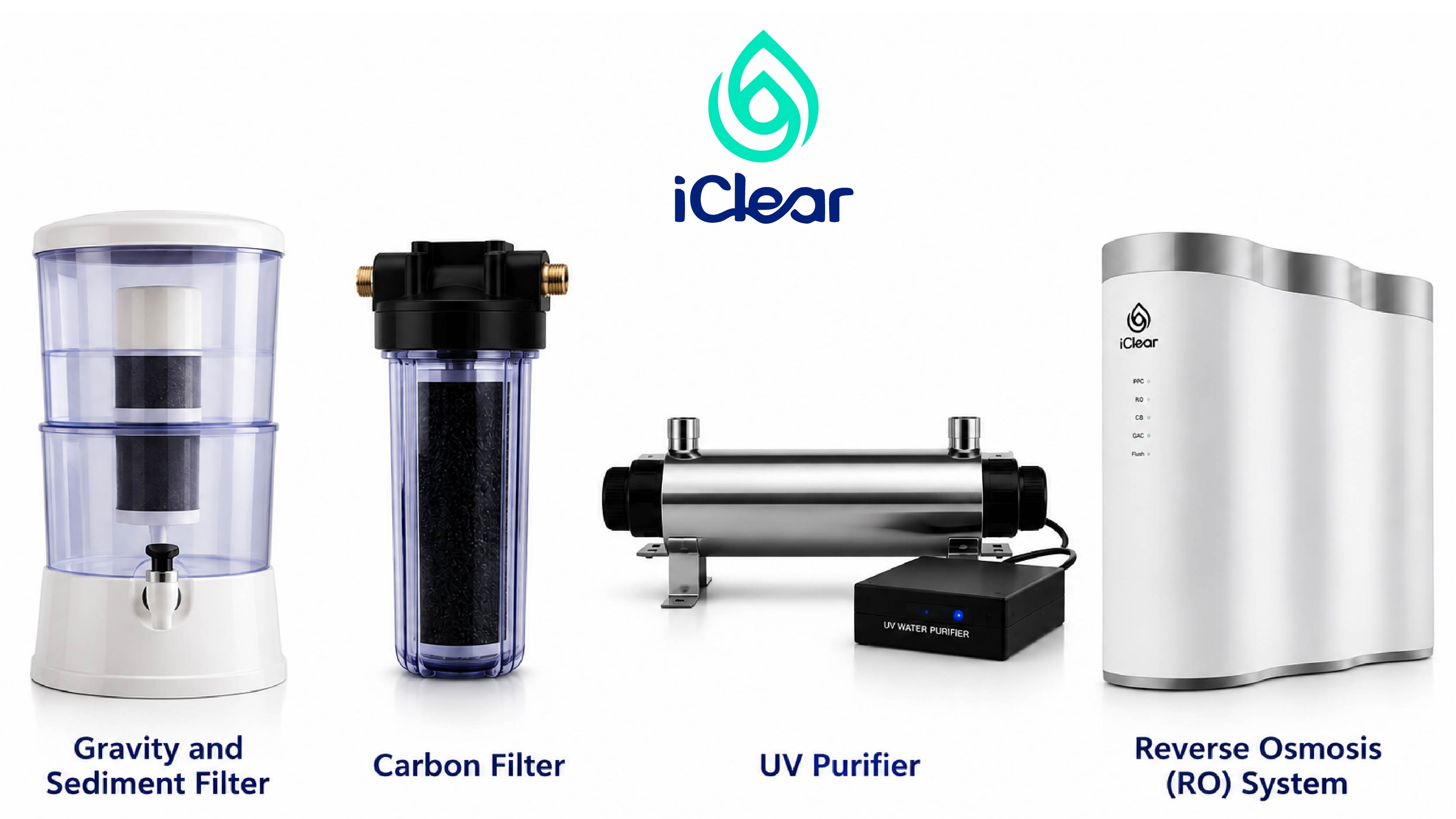
Searching for the best home water filter in Kenya throws up dozens of options, hundreds of opinions, and very little honest guidance. This guide cuts through the noise. Here is what actually matters when choosing a home water filter in Kenya, what to ignore, and how to match a system to your specific water source. First, understand what you are actually filtering The best home water filter is not a universal product. It depends entirely on what is in your water. A home in Nairobi on municipal supply faces different challenges from a home in Nakuru on borehole water, which faces different challenges again from a coastal home dealing with high salinity. Before comparing products, it helps to know the main categories of contaminants found in Kenyan household water: Bacteria and viruses, including E. coli, typhoid, and cholera-causing organisms Heavy metals such as lead, iron, and arsenic Fluoride, particularly high in Rift Valley groundwater Dissolved salts and high total dissolved solids, common in borehole and coastal water Chlorine and chemical residues from municipal treatment The main types of home water filters in Kenya Gravity and sediment filters These are the cheapest and simplest. They remove visible particles and sediment but do nothing about bacteria, dissolved chemicals, heavy metals, or fluoride. For most Kenyan water sources, they are not enough on their own. Carbon filters Carbon filters improve taste and remove chlorine and some organic compounds. They are a useful stage in a larger system but cannot handle heavy metals, fluoride, or dissolved salts when used alone. UV purifiers UV systems kill bacteria and viruses effectively but remove nothing from the water. Dissolved chemicals, fluoride, and heavy metals pass straight through. In Kenya, where dissolved contamination is widespread, UV alone leaves a significant gap. Reverse Osmosis (RO) systems RO is the most comprehensive home water filtration technology available. It removes bacteria, viruses, heavy metals, fluoride, nitrates, dissolved salts, and sediment in a single system by forcing water through a semi-permeable membrane at the molecular level. For the majority of Kenyan homes, especially those on borehole or salty water, Reverse Osmosis is the only single technology that addresses every major contaminant category at once. This is why it has become the standard for serious home water filtration in Kenya. What actually matters when choosing Beyond the technology itself, these are the factors that genuinely affect whether a home water filter is worth buying: KEBS certification, which independently verifies that the system meets Kenya's national safety standards The number of filtration stages, with quality RO systems using 5 to 7 stages Daily output capacity matched to your household size Whether professional installation is included or an extra cost The availability of after-sales support and filter replacements How iClear's home range compares iClear Kenya offers a range of KEBS-certified Reverse Osmosis home filters designed for Kenyan water conditions. The iClear Standard handles everyday household use from borehole, rain, or municipal sources. The iClear Premier serves larger households of 8 to 15 people with a 100 gallon per day capacity. The iClear Desktop is a portable, no-plumbing option for renters and smaller spaces. Every iClear system includes free professional installation in Nairobi, its environs, and Nakuru. No other water purifier brand in Kenya currently offers this as standard, and it removes one of the most common hidden costs in the buying process. The best home water filter in Kenya is the one that removes what your water actually contains, is independently certified, and is installed correctly. For most homes, that points to a KEBS-certified RO system. Ready to find the best water filter for your home? Free delivery and professional installation in Nairobi and Nakuru. Visit the iClear shop. Tags: best home water filters, water filter Kenya, home water filter Kenya, water purifier Kenya, Reverse Osmosis water filter Kenya, iClear Kenya, KEBS certification
 Health & Wellness
 Water Quality Insights
 Health & Wellness