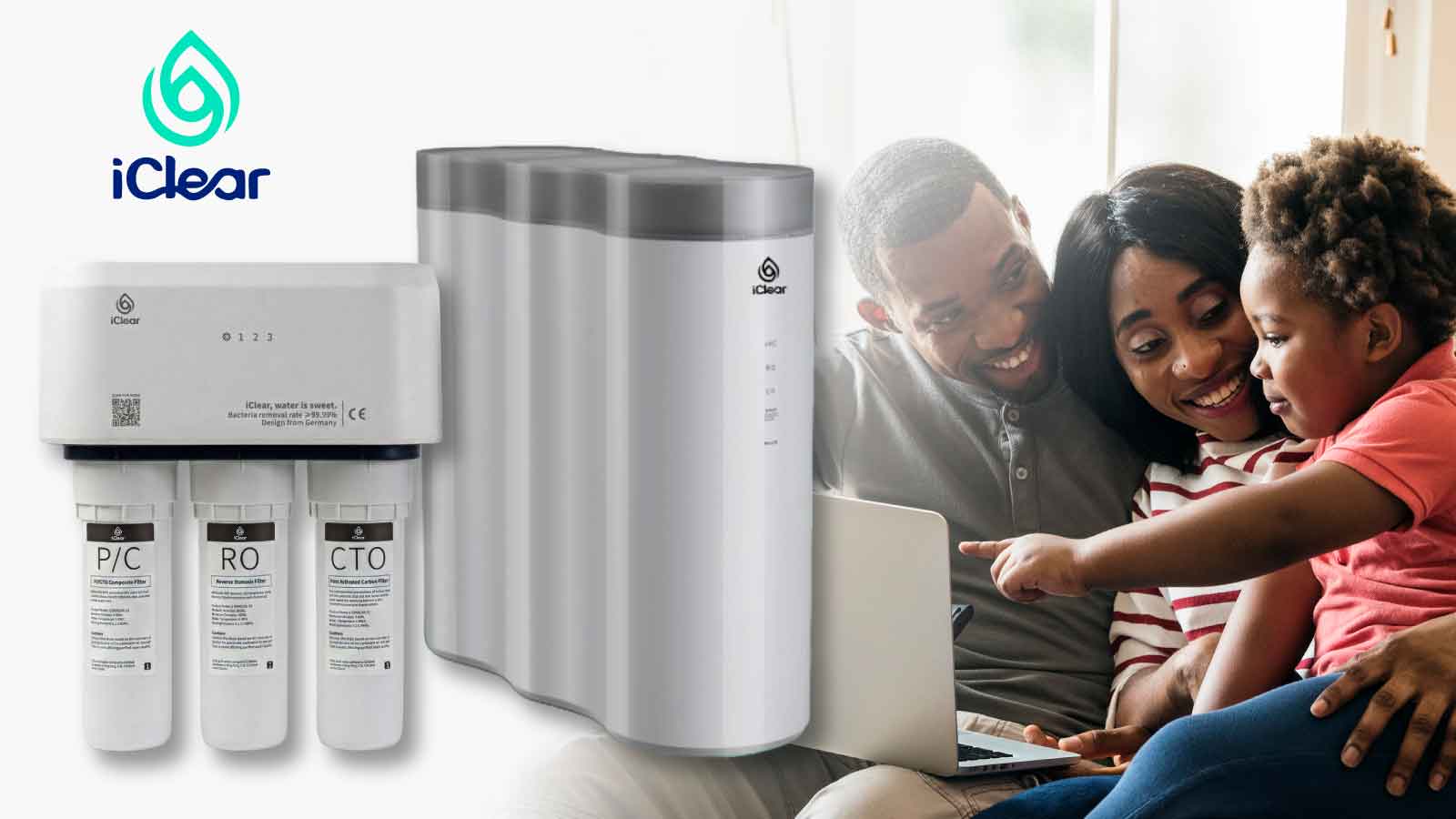

When iClear Kenya opened its doors four years ago, it walked into a market that didn’t quite believe it had a problem. Clean water, for most Kenyan households, was something you boiled, bought in a twenty-litre dispenser, or simply trusted because it looked clear coming out of the tap. The idea that the water in your home, even when it looked fine, might still be doing quiet damage to your health was not yet part of the everyday conversation. That gap between what people knew and what was actually flowing through their pipes is where iClear chose to plant itself. Today, four years later, the company operates from Ecobank Towers in Nairobi and a branch in Nakuru, with a product range spanning the iClear Standard, the iClear Desktop, the iClear Premier, and an Office-Use leasing model built for workplaces. But getting here was not a straight line. The hardest part was not the product. It was the belief. Ask the team about the toughest stretch of those first two years and the answer is not about logistics, pricing, or competition. It was about trust. The market either didn’t believe it needed water filtration in the first place, or it had already been burned by low-quality systems that promised much and delivered little. Convincing a customer that clean water was a necessity, not a luxury, took time. So iClear leaned into something more patient than marketing. It leaned into education. Instead of pitching, the team started showing. Customers were walked through the actual condition of their water, what was in it, what came out of the filter, and what it meant for the people drinking it every day. That demonstration, paired with reliable installation and after-sales service, started doing the work that no advert could. “Word-of-mouth started working in our favour.” What actually moved the needle Looking back over four years, the single biggest engine of growth has not been a campaign, a discount, or a clever channel. It has been customer referrals and reviews. When a household experienced the difference, the kind of difference you can see, taste, and feel within days, they told their friends, their family, their neighbours, sometimes their entire WhatsApp group. Behind those referrals sat one quiet, deliberate decision. iClear chose, early on, to prioritise long-term customer satisfaction over the short-term sale. That meant investing in proper installation rather than rushing the job, building support that customers could actually reach, and making sure every buyer genuinely understood what their system was doing for them. The pay-off arrived slowly, then all at once, in the form of repeat business, organic referrals, and a reputation the team didn’t have to buy. A different customer than the one we started with Four years has also changed who walks through iClear’s door. In year one, the typical customer was an early adopter. Someone who was already health-conscious, or someone whose water had given them a visible problem they could no longer ignore, discolouration, sediment, the kind of issues you cannot un-see once you’ve seen them. Today the picture looks different. Families, offices, and even landlords are arriving proactively, before there is a visible problem. They ask sharper questions. They compare options. They make decisions faster, because the awareness around water quality has finally caught up with the reality. The conversation iClear was trying to start four years ago is now a conversation Kenyan households are starting on their own. Where the next chapter goes If the first four years were about building trust in a sceptical market, the next chapter is about reach. The goal is to make clean, safe water available to more households across Kenya, not only in the major cities but in the towns and suburbs where filtration is still treated as an afterthought. That means expanding distribution, sharpening service efficiency, and continuing the patient work of educating the market. The ambition is simple to state and harder to deliver. Make water filtration a standard in the Kenyan home, not a niche purchase. Four years in, iClear is closer to that than it was when it started, and the conversation has moved with it. iClear Kenya is marking its fourth anniversary in June 2026.
Your office water dispenser looks clean. It dispenses clear water. Your team uses it dozens of times a day without a second thought. But inside the tank, the pipes, the spigots, and the drip tray, something else is happening, and the research on what grows in neglected water dispensers is not comfortable reading. What actually lives inside a water dispenser Water dispensers, both the bottle-fed variety and countertop units, create ideal conditions for microbial growth. The interior surfaces are dark, damp, and rarely exposed to cleaning agents. Water sits in the reservoir for hours or days between uses. And in Kenya's warm climate, that sitting water reaches temperatures that accelerate bacterial proliferation. Studies on office water dispensers have found contamination with coliform bacteria, Pseudomonas aeruginosa, Legionella, Staphylococcus, and various moulds and yeasts. These are not rare or exotic pathogens. They are opportunistic organisms that thrive in exactly the kind of environment a neglected water dispenser provides. Research published in the International Journal of Environmental Research and Public Health found bacterial contamination in a significant proportion of office water dispensers tested, with coliform bacteria, an indicator of faecal contamination, present in samples that had passed visual inspection as clean. The parts of your dispenser that nobody cleans The water reservoir The internal reservoir of a bottled water dispenser is almost never cleaned in practice. It sits permanently enclosed, dark, and moist. Biofilm, a sticky layer of bacteria embedded in a protective matrix, forms on internal surfaces over weeks and months. Once established, biofilm is extremely difficult to remove and acts as a continuous source of bacterial contamination in every glass of water dispensed. The spigots The dispensing spigots, the taps your team touches dozens of times a day, accumulate bacteria from hands, from ambient air, and from water droplets that dry and concentrate contaminants on the surface. Studies have found that dispenser spigots carry some of the highest bacterial loads of any surface in office environments. The drip tray The drip tray collects overflow water that sits, stagnates, and becomes a breeding ground for mould and bacteria. From the tray, airborne contamination can reach the dispensing area and the water itself. Most offices empty the drip tray occasionally. Very few sanitise it. The bottle neck and collar When a 20-litre bottle is inverted and placed on the dispenser, the bottle neck is exposed to ambient air, hands, and the collar of the dispenser unit. This is a contamination point that is essentially impossible to control without a sealed, plumbed system. The recommended cleaning frequency for office water dispensers is every six to twelve weeks. Most Kenyan offices clean theirs once a year, if that. The gap between recommendation and reality is where the contamination happens. The symptoms your team might be attributing to something else Recurring stomach upsets, unexplained nausea, persistent low-grade illness among multiple team members, these are the kinds of symptoms that tend to be attributed to food, stress, or seasonal illness. In offices with contaminated water dispensers, the water is frequently the overlooked source. Pseudomonas infections, while most dangerous in immunocompromised individuals, can cause gastrointestinal symptoms in otherwise healthy adults with sustained low-level exposure. Legionella, in its milder form known as Pontiac fever, causes flu-like symptoms that most people recover from without ever identifying the source. The solution: eliminate the dispenser entirely iClear Kenya offers an office water purification system that removes the dispenser from the equation entirely. The iClear office water purifier connects directly to your water supply, purifying water through multi-stage RO and UV filtration at the point of use. There is no reservoir for bacteria to colonise, no bottles to invert and expose, and no drip tray to stagnate. Water is purified on demand and dispensed immediately. Every glass your team drinks is fresh, clean, and free from the contamination risks that accumulate in bottle-fed dispenser systems over time. The iClear office water filtration system is available under an annual agreement that covers installation, maintenance, and free servicing every four months. Free delivery and professional installation is included in Nairobi, its environs, and Nakuru. The cleanest dispenser in your office is the one that does not exist. A plumbed, point-of-use iClear system gives your team unlimited purified water with no reservoirs, no bottles, and no contamination risk hiding in a unit nobody remembers to clean. Is your office water dispenser putting your team at risk? Contact iClear Kenya today and replace it with a purified, on-demand water solution. Free delivery and professional installation in Nairobi and Nakuru. Tags: office water purifier Kenya, iClear Kenya, water purifier Kenya, water filtration system Kenya, iClear water purifier, office water filtration system, water purification machine
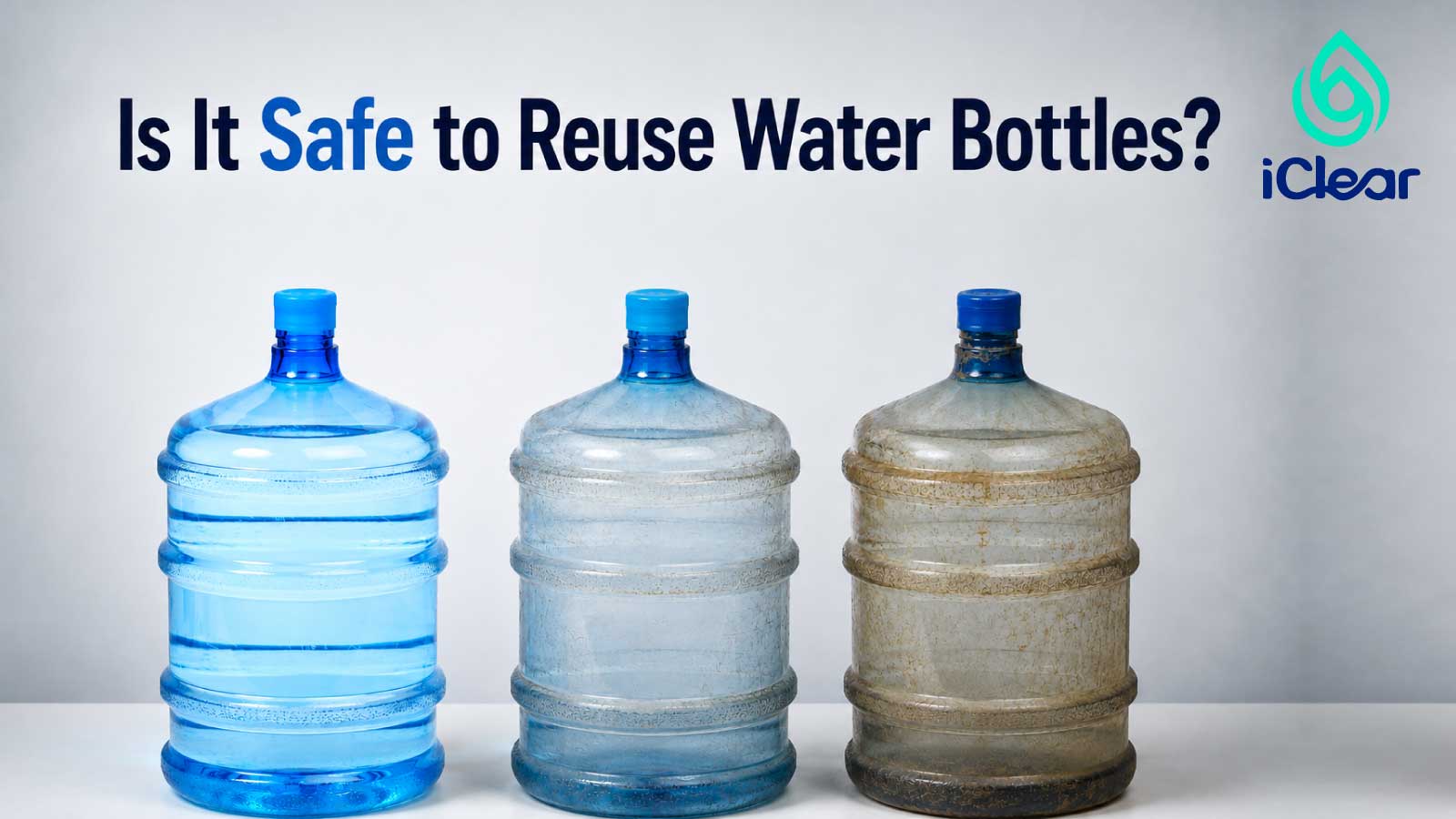
Bottled water has one of the most successful marketing stories in history. The clear plastic, the pristine mountain imagery, the promise of purity. Millions of Kenyans pay a significant premium for it every month, confident they are getting something cleaner and safer than tap water. The evidence suggests otherwise. What studies have actually found in bottled water Research into bottled water quality has produced findings that the industry would prefer you did not read. A landmark 2018 study by Orb Media, conducted across 11 major bottled water brands sold in nine countries, found that 93% of bottles tested contained microplastic contamination. The average bottle contained 325 microplastic particles per litre. Separate studies have identified coliform bacteria, including strains of E. coli, in commercially bottled water products. A study published in the journal Environmental Science and Technology found that the longer water sits in a plastic bottle, especially in warm conditions, the greater the leaching of chemical compounds including antimony and BPA into the water itself. Water dispenser with bacteria infographic 93% of major bottled water brands tested contained microplastic particles. The average was 325 particles per litre. You cannot see them. You cannot taste them. And you are drinking them. The specific problems with bottled water in Kenya Storage and heat exposure Kenya's climate accelerates the chemical breakdown of plastic bottles. When PET bottles are exposed to heat, whether in a delivery truck, a warehouse, or direct sunlight outside a shop, the plastic begins to leach compounds into the water. BPA and phthalates, both of which are linked to hormonal disruption and long-term health effects, are released at higher rates as temperature increases. The water in that bottle sitting in the sun outside a Nairobi duka is not the same as what left the factory. Reuse of single-use bottles A common practice across Kenyan homes and offices is the refilling of single-use plastic bottles, either from dispensers, taps, or 20-litre delivery containers. Single-use PET bottles are designed for one fill. Each refill and wash degrades the plastic further, increasing leaching. The bacteria that accumulate in the neck and cap of a repeatedly used bottle are a contamination source in their own right. 20-litre dispenser bottles and hygiene The large 20-litre bottles used in office and home water dispensers present their own hygiene challenges. These bottles are collected, washed, refilled, and redistributed by suppliers, and the quality of that washing process is entirely beyond the consumer's visibility. Studies on refillable water containers have found bacterial contamination in a significant proportion of bottles in active circulation. Regulatory gaps In Kenya, bottled water is regulated but enforcement varies significantly across producers. Smaller, informal bottling operations that supply local markets may meet KEBS standards on paper while operating with inadequate quality control in practice. The consumer has no reliable way to distinguish a rigorously tested product from one that is not. You pay a premium for bottled water on the assumption that someone else has ensured its safety. But between the factory, the warehouse, the delivery truck, and your shelf, that assumption takes a lot on trust. What Kenyans are doing instead A growing number of Kenyan households and businesses are switching from bottled water to point-of-use water purification machines, systems that purify water at the moment you drink it, with no storage, no plastic, and no supply chain involved. The iClear water purifier uses multi-stage Reverse Osmosis filtration to produce water that consistently meets or exceeds bottled water quality standards, without microplastics, without chemical leaching from plastic, and without the hygiene uncertainty of the bottled water supply chain. The water it produces is tested to KEBS certification standards and delivered fresh, on demand, directly from your tap. For most Kenyan households, switching to iClear also saves money. The average household spending KES 3,000 to 8,000 per month on bottled water eliminates that cost entirely after purchasing an iClear system, with free delivery and professional installation included in Nairobi, its environs, and Nakuru. The cleanest water is not the one that travels furthest in a plastic bottle. It is the one purified at the point of use, on demand, by a system you control. That is exactly what iClear delivers. Stop paying for water you cannot fully trust. Contact iClear Kenya today and make the switch to certified, on-demand pure water. Free delivery and installation in Nairobi and Nakuru. Tags: water purifier Kenya, iClear water, water purification machine, water filter Kenya, iClear Kenya, iClear Wellife, bottled water Kenya
Borehole water it’s one of the most common drinking water sources in Kenya, relied upon by millions of households in both rural and urban areas. It feels clean. It looks clear. And many Kenyans have been drinking it for years without obvious ill effects. But the real question is not whether it tastes fine. It is whether it is actually safe. Why borehole water feels safe but often is not The most dangerous contaminants in borehole water are invisible. They have no colour, no smell, and no taste. This is what makes borehole water particularly deceptive: it can look and taste perfectly fine while carrying contaminants that cause serious harm over time. Unlike surface water, which shows visible signs of contamination, borehole water draws from underground aquifers. These aquifers absorb minerals, chemicals, and in some cases biological contaminants from the surrounding geology and soil, a process that takes place out of sight, deep underground, long before the water ever reaches your tap. Borehole water in Kenya has been found to contain elevated levels of fluoride, nitrates, iron, arsenic, coliform bacteria, and in coastal regions, high salinity. Many of these contaminants are odourless and tasteless. You will not know they are there until the health effects appear. The specific risks of borehole water in Kenya Fluoride The Rift Valley and large parts of central Kenya sit on geological formations naturally high in fluoride. Long-term consumption of fluoride above safe levels causes dental fluorosis, visible as brown staining and pitting on teeth, and in more severe cases, skeletal fluorosis, a painful and debilitating bone condition. Children are particularly vulnerable. Nitrates Nitrate contamination in borehole water typically comes from agricultural runoff, pit latrines, and septic systems. High nitrate levels are especially dangerous for infants, causing a condition known as blue baby syndrome, where the blood's ability to carry oxygen is severely reduced. In adults, long-term exposure is linked to increased cancer risk. Iron and manganese Elevated iron levels are extremely common in Kenyan borehole water. While not immediately dangerous in small quantities, high iron content stains plumbing and laundry, damages appliances, and can cause liver damage with sustained long-term consumption. Manganese at elevated levels is linked to neurological effects, particularly in young children. Bacteria and pathogens Borehole water is not automatically sterile. Coliform bacteria, including E. coli, can infiltrate aquifers through poorly constructed boreholes, cracked casings, or proximity to latrines and waste sites. These bacteria cause gastroenteritis, diarrhoea, and in severe cases, life-threatening illness. Salinity and total dissolved solids In parts of Kenya, particularly coastal and semi-arid regions, borehole water can carry extremely high levels of dissolved salts and minerals. Long-term consumption of high-TDS water puts strain on the kidneys and cardiovascular system. What boiling does and does not fix Many Kenyan households boil their borehole water believing this makes it safe. Boiling is effective at killing bacteria and viruses. But it does nothing to remove fluoride, nitrates, heavy metals, or dissolved salts. In fact, boiling concentrates these dissolved contaminants by reducing water volume. Boiling contaminated borehole water does not make it safer from a chemical standpoint. It can actually make it worse. Boiling kills biological threats but leaves chemical ones behind. For borehole water in Kenya, only Reverse Osmosis filtration removes both categories of contamination reliably and completely. The only solution that covers all borehole water risks Reverse Osmosis is the only technology capable of removing the full spectrum of borehole water contaminants in a single system. The iClear water purifier uses multi-stage RO filtration to strip out fluoride, nitrates, heavy metals, bacteria, viruses, dissolved salts, and sediment, delivering water that is genuinely safe regardless of what the borehole source contains. iClear Kenya provides free delivery and professional installation in Nairobi, its environs, and Nakuru. Their systems are KEBS-certified and designed specifically for Kenya's diverse and often challenging water conditions. If your home relies on borehole water, the question is not whether to treat it. The question is whether you are treating it thoroughly enough. A basic filter is not enough. An iClear Reverse Osmosis system is. Is your borehole water actually safe? Contact iClear Kenya today. Our team will help you choose the right RO purifier for your water source, with free delivery and installation in Nairobi and Nakuru. Tags: borehole water Kenya, water purifier Kenya, water purification machine, water filter Kenya, iClear water purifier, iClear Kenya, Reverse Osmosis water filter Kenya, domestic water purifiers Kenya
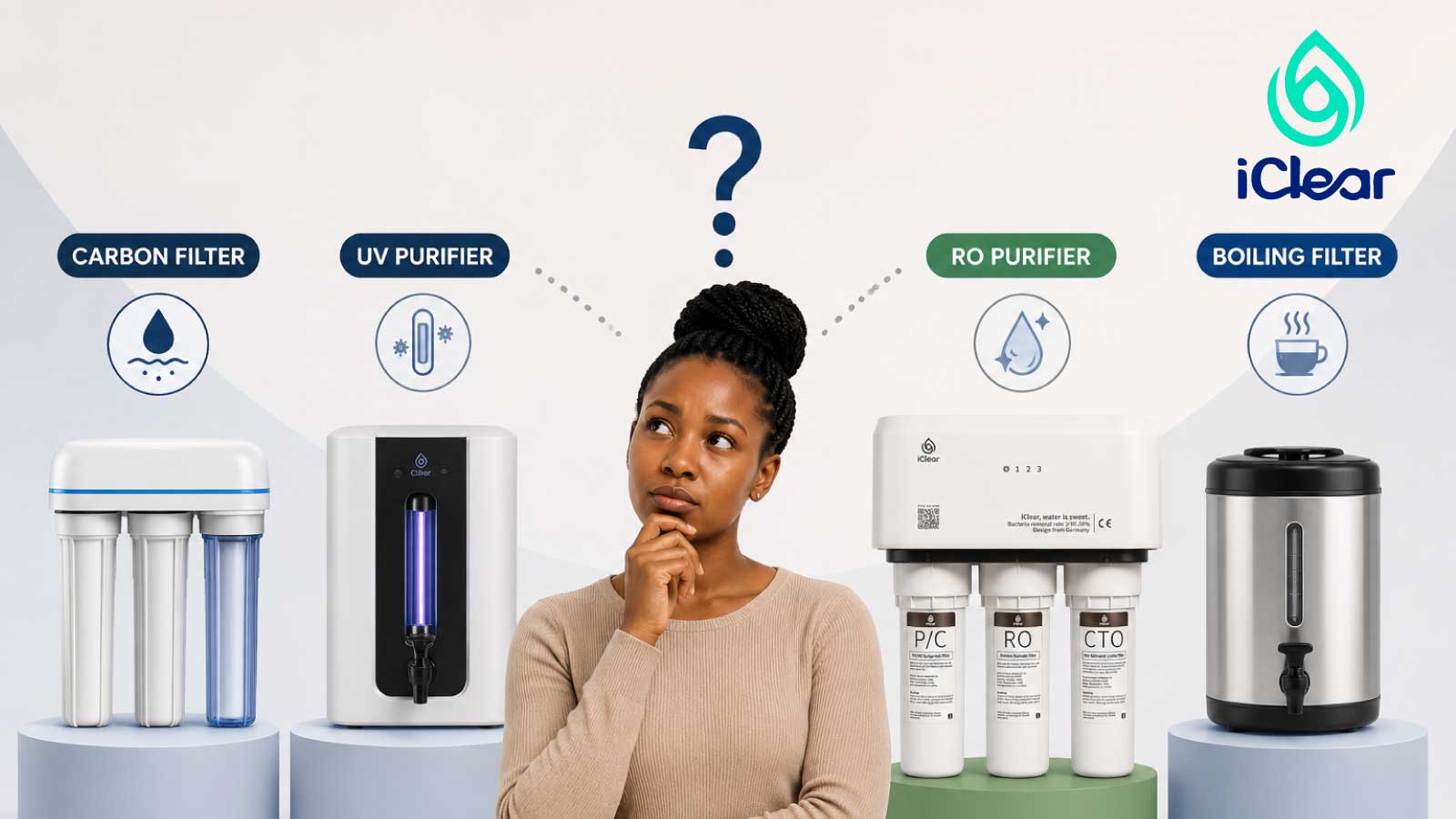
The Kenyan water purifier market is full of options. Carbon filters, ceramic systems, UV purifiers, gravity filters, each one promises clean water. But not all of them deliver. Here is an honest, side-by-side look at how the leading technologies compare, and why Reverse Osmosis consistently comes out ahead for Kenyan homes and offices. The challenge with Kenya's water Before comparing technologies, it helps to understand what a water purifier in Kenya actually needs to deal with. Kenyan water sources carry a wide and unpredictable range of contaminants: bacteria and viruses from microbial activity, fluoride and nitrates from geological deposits, heavy metals from ageing pipes, chlorine residues from municipal treatment, and sediment from surface or borehole sources. A water purification system that only handles one or two of these categories leaves your household or office exposed to the rest. This is the core problem with most alternative technologies. How the technologies compare Technology Removes Bacteria Removes Heavy Metals Removes Fluoride Removes Viruses Handles Borehole Water Reverse Osmosis (iClear) Yes Yes Yes Yes Yes Carbon Filter Partial No No No No UV Purifier Yes No No Yes No Ceramic Filter Yes No No No No Gravity Filter Partial No No No No Why carbon filters fall short in Kenya Carbon filters are excellent at improving the taste and smell of water by removing chlorine and organic compounds. They are a good first stage in a multi-step system. But used alone, they do not remove dissolved heavy metals, fluoride, nitrates, or viruses. For Kenyan households dealing with borehole water or high fluoride levels, a carbon filter alone is not enough. Why UV purifiers miss the mark UV purification is highly effective at killing bacteria and viruses by disrupting their DNA. However, it has one critical limitation: it does not remove anything from the water. It kills biological contaminants but leaves dissolved chemicals, heavy metals, fluoride, and sediment entirely untouched. In Kenya, where dissolved mineral contamination is widespread, UV alone leaves a significant portion of the problem unaddressed. Why ceramic filters are not enough Ceramic filters are affordable and effective at removing sediment, bacteria, and some protozoa. They are a reasonable entry-level option in areas with relatively clean water sources. But they are slow, require regular cleaning to maintain performance, and like UV systems, offer no protection against dissolved chemical or metal contaminants. Why Reverse Osmosis wins Reverse Osmosis is the only single technology that addresses all major categories of water contamination simultaneously. By forcing water through a semi-permeable membrane at the molecular level, it removes bacteria, viruses, dissolved heavy metals, fluoride, nitrates, chlorine byproducts, and sediment in one continuous process. For Kenya's diverse and often unpredictable water quality, this comprehensiveness is not just a benefit. It is a necessity. You cannot always know exactly what is in your water. RO removes virtually all of it regardless. Reverse Osmosis does not just target the contaminants you know about. It removes what you do not. For Kenyan homes and offices dealing with borehole water, municipal supply, or salty groundwater, that matters enormously. Why iClear's RO system stands apart Not all RO systems are equal. iClear Wellife Service Limited builds its purifiers specifically for Kenya's water conditions, using multi-stage RO filtration that has been KEBS-certified by the Kenya Bureau of Standards. Every iClear system is independently verified to meet Kenya's highest water safety benchmarks. Beyond the technology, iClear Kenya provides free delivery and professional installation in Nairobi, its environs, and Nakuru. No other water purifier brand in Kenya offers this as standard. Incorrect installation is one of the most common reasons RO systems underperform, and iClear eliminates that risk entirely. When you compare what each technology actually delivers against Kenya's real water challenges, Reverse Osmosis is not just the best option. It is the only option that covers everything. And iClear is Kenya's most trusted way to access it. Ready to switch to the most comprehensive water purification available? Contact iClear Kenya today. Free delivery and professional installation in Nairobi and Nakuru. Tags: water purifier Kenya, water filter Kenya, Reverse Osmosis water filter Kenya, iClear Kenya, iClear Wellife Service Limited, water purification machine, iClear water purifier
Across Kenya, borehole water is treated as a reliable, even premium, alternative to municipal supply. And in some respects, that reputation is deserved. Boreholes are often cleaner than surface water and free from municipal treatment chemicals. But clean is not the same as safe. Here is what borehole water can hide, and how iClear eliminates the risk. The problem no one warns you about When a borehole is drilled, families often assume that because the water comes from deep underground, it must be pure. This assumption is understandable but dangerous. Underground aquifers absorb whatever is in the surrounding geology. In Kenya, that often includes naturally occurring fluoride, arsenic, and dissolved minerals that no amount of settling, boiling, or basic filtering can remove. The health consequences of long-term exposure to these contaminants are serious and largely irreversible. Dental and skeletal fluorosis, kidney damage from heavy metals, and neurological effects from elevated manganese do not appear overnight. They accumulate silently over years, which is exactly what makes them so dangerous. The communities in Kenya with the highest rates of dental fluorosis are predominantly those relying on untreated borehole water. Children who grow up drinking fluoride-contaminated water suffer permanent tooth and bone damage that no treatment can fully reverse. Five hidden dangers in Kenyan borehole water 1. Fluoride that destroys teeth and bones Kenya's Rift Valley and central highlands sit on volcanic rock that is naturally rich in fluoride. The WHO safe limit for fluoride in drinking water is 1.5mg per litre. Many Kenyan borehole sources exceed this significantly. Chronic exposure causes fluorosis, presenting as brown and pitted teeth in children and progressive bone pain and deformity in adults. Effects of fluoride on teeth. Image Courtesy: https://www.news24.com/citypress 2. Nitrates that threaten infants Agricultural activity, pit latrines, and poorly managed waste sites leach nitrates into groundwater over time. Infants fed with water containing high nitrate levels are at risk of methemoglobinemia, commonly called blue baby syndrome, a potentially fatal condition that prevents blood from carrying adequate oxygen. 3. Arsenic with no safe threshold Arsenic occurs naturally in some Kenyan geological formations and finds its way into borehole water without any visual sign. The WHO classifies arsenic as a Group 1 carcinogen. There is no safe level of long-term arsenic consumption. It is linked to cancers of the skin, bladder, and lung, as well as cardiovascular and neurological damage. Skin lesions are one obvious sign of arsenic poisoning. Image Courtesy: https://news.climate.columbia.edu/2015/07/13/battling-the-largest-mass-poisoning-in-history/ 4. Bacteria from unseen sources Even deep boreholes can become contaminated with coliform bacteria if the casing is cracked, if the borehole head is improperly sealed, or if there are nearby sources of waste. Families who have been drinking from the same borehole for years with no obvious problems can still be consuming low-level bacterial contamination that accumulates in the body over time. 5. Heavy metals that damage organs Lead, manganese, and iron are common in Kenyan groundwater. Lead has no safe exposure level and causes irreversible neurological damage, particularly in children under five. Manganese at elevated levels is associated with cognitive impairment. These metals are entirely undetectable by taste or smell. How iClear eliminates every one of these risks The iClear water purification machine for home use employs multi-stage Reverse Osmosis technology to remove all five categories of borehole water contamination in a single system. The RO membrane operates at the molecular level, blocking fluoride, nitrates, arsenic, heavy metals, and bacteria before they reach your glass. Unlike boiling, which leaves dissolved chemical contaminants behind, and unlike basic carbon or ceramic filters, which cannot penetrate molecular-level contamination, iClear's domestic water purifier delivers genuinely safe water regardless of what the borehole source contains. Every iClear Kenya system is KEBS-certified, ensuring it has been independently verified to meet national water safety standards. And every purchase comes with free delivery and professional installation in Nairobi, its environs, and Nakuru, carried out by trained technicians who understand Kenya's specific water challenges. Protecting your family from borehole water contamination is not about worrying more. It is about doing one thing correctly: installing a water purification system that removes what you cannot see, taste, or smell. iClear makes that simple. Do not wait for the health effects to appear. Contact iClear Kenya today and find the right home water purifier for your borehole source. Free delivery and professional installation in Nairobi and Nakuru. Tags: domestic water purifiers Kenya, water purification machine for home use, iClear Kenya, water filter Kenya, borehole water Kenya, iClear water purifier, Reverse Osmosis, water purification machine
The WQA Convention & Expo 2026 in Miami brought together some of the most advanced companies and professionals in the global water treatment industry. For companies operating in emerging markets like Africa, events like WQA are more than just exhibitions. They are an opportunity to understand where the industry is heading and how those innovations can be adapted locally. At iClear, as we continue building clean water solutions across Kenya and expanding into West Africa, these insights are critical in shaping a long-term, scalable service model. Desmond Okpei, iClear Water Lagos, attending WQA 2026 in Miami Beach as a Water Pro member. 1. Shift Toward Tankless and Compact Systems One of the most visible trends at WQA 2026 is the increasing adoption of tankless reverse osmosis (RO) systems, a category the Water Quality Association has highlighted as a defining shift in modern residential and commercial water treatment. Compared to traditional tank-based systems, tankless units offer: Faster water flow Reduced risk of secondary contamination More compact installation The African Reality While tankless systems are gaining traction globally, their adoption in African markets requires careful consideration: Power stability Water pressure conditions Cost sensitivity In many cases, a hybrid approach, balancing performance, durability, and affordability, is more suitable for local households. "The Evolution of the Tankless RO" was a headline session at WQA 2026, reflecting how central this shift has become to the global industry conversation. "The Evolution of the Tankless RO" session at WQA 2026, Miami Beach. 2. Growing Importance of Smart Water Systems Another clear trend is the integration of smart features into modern water purification systems: Real-time TDS monitoring Filter life tracking Mobile app connectivity Applying This in Kenya and Nigeria In markets like Kenya and Nigeria, smart features can add value, but must be applied selectively: Simplicity remains key for mass adoption Reliability is more important than complexity Cost-performance balance is critical The opportunity lies in bringing the right level of technology, not the most advanced one. 3. From Product Sales to Service Models Globally, leading water companies are shifting from selling equipment to providing ongoing water services. This includes: Subscription-based filter replacement Regular maintenance plans Long-term customer relationships Why This Matters Most for Emerging Markets This is one of the most important directions for emerging markets, where three realities converge: Bottled water is widely used but expensive and unreliable Water quality is inconsistent across sources and regions Maintenance is often neglected after the initial purchase A service-driven model can improve water safety, reduce long-term cost, and build recurring revenue and trust. This directly informs how iClear structures its office water purification agreements in Kenya, which include free servicing every four months as part of the annual arrangement. Service models were a recurring theme across the WQA 2026 keynote sessions, reinforcing what iClear has already built into its business model for the Kenyan market. The WQA 2026 keynote hall in Miami Beach, where service models and global water trends took centre stage. 4. Increasing Focus on Water Safety and Health Awareness Global conversations at WQA increasingly emphasise themes that align closely with the WHO Guidelines for Drinking-Water Quality: Bacteria and contaminant removal Health impact of poor water quality Consumer education as a driver of adoption The Local Picture Awareness is rising across Kenya and West Africa, but still uneven across regions. This creates both challenges and opportunities. Companies that invest in educating users, not just selling products, will have a long-term advantage. In Kenya, that also means anchoring product claims in recognised standards such as KEBS certification, so customers can trust what they are buying. iClear's KEBS-certified systems speak directly to this need. 5. Supply Chain and Component Innovation The WQA 2026 exhibition also highlighted significant advancements in the underlying components that power water purification systems: Next-generation filter materials with longer operational lifespans Membrane technology improvements that increase throughput and efficiency System component standardisation that reduces maintenance complexity For iClear, staying current with these developments ensures that as we scale across Africa, our systems continue to meet global performance standards adapted for local operating conditions. How iClear Applies These Insights At iClear, our focus is not just on introducing new products, but on building a system that works in real local conditions. The WQA 2026 insights reinforce three pillars already central to our strategy: Kenya: a direct-to-customer model with professional installation, free delivery in Nairobi and Nakuru, and regular after-sales service built into every agreement Nigeria and West Africa: expansion through strategic partnerships that bring proven technology to new markets without compromising on quality or service Alignment of global insights with local realities, ensuring that what we offer is not just globally competitive but genuinely fit for purpose across Africa The gap between global innovation and African adoption is not a technology gap. It is an adaptation gap. iClear's role is to close it. Conclusion: Global Learning, Local Execution The future of water solutions will not be defined by technology alone, but by how well that technology is adapted to local environments. WQA 2026 reinforced three principles that guide everything iClear does: Practical solutions over complex systems Service models over one-time sales Long-term reliability over short-term performance As the global water treatment industry accelerates, Africa's water challenge remains both urgent and significant. The companies that will lead are those that understand the continent, serve it directly, and build for the long term. iClear is one of them. Want to learn more about iClear's approach to clean water in Africa? Contact iClear Kenya today. Free delivery and professional installation in Nairobi and Nakuru. Tags: water filtration trends 2026, water purification Africa, RO water system Africa, clean water solutions Kenya Nigeria, tankless RO vs tank system, iClear Kenya, KEBS certification
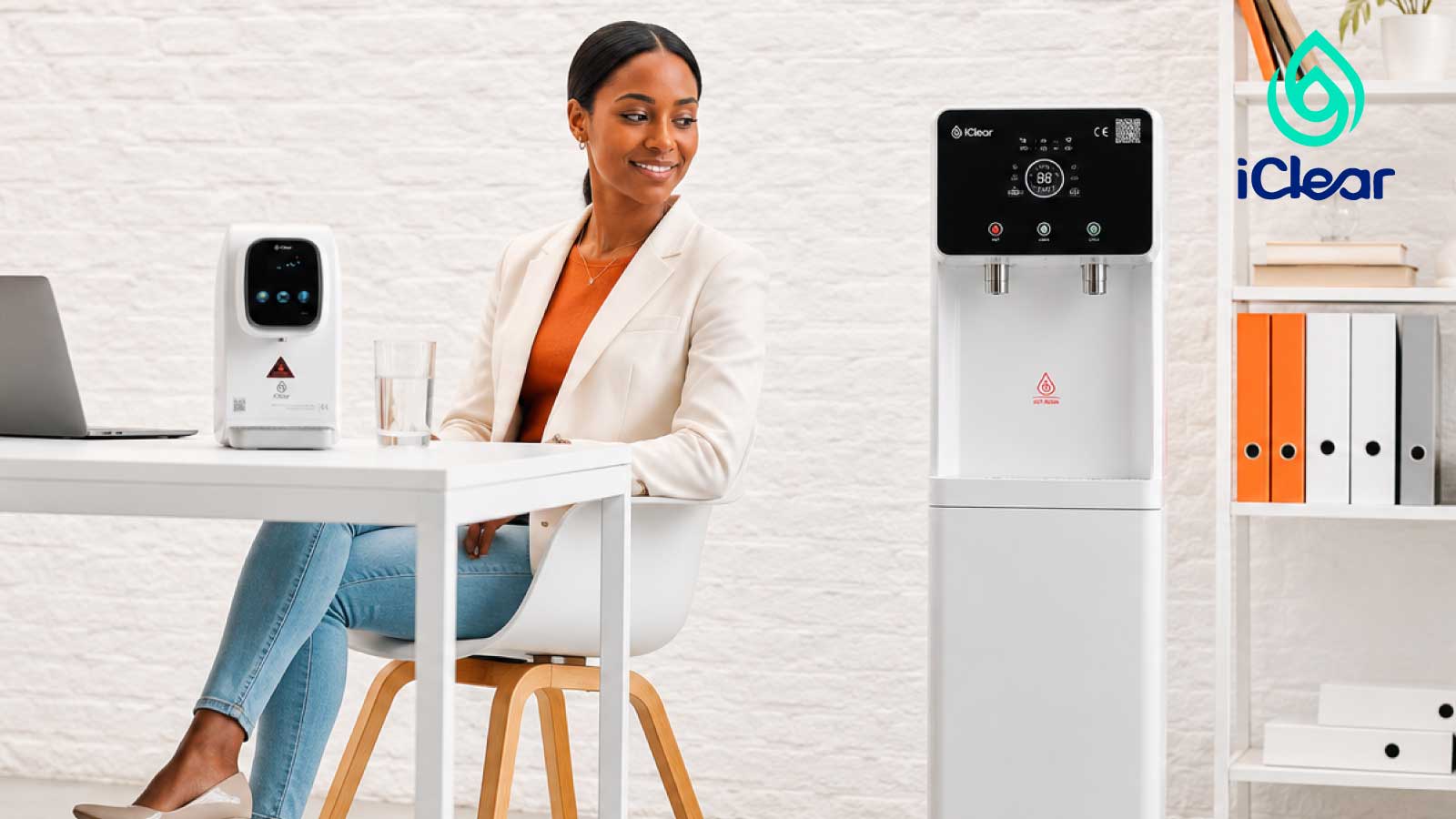
For many Kenyan businesses, the idea of installing a high-quality water purification system has always made sense in theory. The barrier has been the cost. iClear's office water purification agreement removes that barrier entirely. Here is how it works and why it is changing the way Kenyan offices think about clean water. The traditional problem with office water in Kenya Walk into most Kenyan offices and you will find one of two things: a bottled water dispenser or direct tap access. Both are imperfect. Bottled water is expensive at scale, environmentally damaging, and only as clean as the bottling and delivery process allows. Tap water carries risks that municipal treatment alone does not eliminate, particularly in offices served by older building infrastructure. The obvious solution, a high-performance office water purification machine, has often been dismissed as too expensive to install or too complex to maintain. iClear's annual agreement was designed specifically to address both of these objections. How the iClear office agreement works iClear Wellife Service Limited offers Kenyan businesses access to its office-grade water purification system under a straightforward annual arrangement. The process is simple: 1. Consultation: iClear's team assesses your office's water source, daily consumption needs, and physical setup to recommend the right system for your environment. 2. Installation: The system is delivered and professionally installed at no additional cost. iClear's trained technicians handle the entire process, including integration with your existing water supply. 3. Annual agreement: Your business pays a one-time installation fee of KES 10,000, then KES 80,000 for the first year. From Year 2 onwards, the annual cost reduces to KES 80,000. Free maintenance and servicing is included every four months throughout the agreement. 4. Ongoing support: iClear's team provides scheduled maintenance visits every four months and is available for any service needs that arise, ensuring consistent water quality throughout the year. The iClear office agreement converts what would otherwise be a large capital investment into a predictable annual operational cost. For finance and procurement teams, this makes approval straightforward and budgeting simple. What the agreement costs vs. what it saves The financial case for switching from bottled water to an iClear office water filtration system is compelling. Consider a typical Kenyan office of 30 employees: Monthly bottled water expenditure for 30 employees: KES 12,000 to 20,000, totalling up to KES 240,000 per year iClear Office Purifier: KES 10,000 installation + KES 80,000 Year 1 = KES 90,000 total, inclusive of free servicing every four months From Year 2: KES 80,000 per year with continued free maintenance Most offices recover the full first-year cost within months and go on to save over KES 100,000 every year after. The two iClear office purifier options iClear offers two systems suited to different office sizes and setups: iClear Office Water Purifier (Lease) - for 20 to 30 staff A bottleless RO and UV system connected directly to your water supply. It delivers unlimited hot and cold purified water on demand, with sensory touch controls, separate hot and cold outlets with a safety lock, and a compact design that takes up minimal space. Maintenance and servicing every four months is included at no extra cost. iClear Desktop Water Purifier - for smaller teams and shared workspaces A portable RO purifier with instant 3-second hot water and six precise temperature settings. No plumbing required. Includes a built-in 4-litre storage tank, a digital touch screen, and low power consumption. Priced at KES 40,000 as a one-time purchase, it suits smaller offices, home offices, and apartments. Why the iClear annual agreement beats outright bottle purchasing The iClear office agreement is not a traditional lease. It is an annual service arrangement that gives your business access to a high-performance water purification system, with all maintenance handled by iClear's technicians on a scheduled basis every four months. For offices, this removes three common pain points at once: the capital cost of purchasing a commercial system outright, the operational burden of managing bottled water logistics, and the risk of equipment underperformance due to missed servicing. Everything is covered under one predictable annual amount. KEBS-certified technology, professionally installed Every iClear water purifier offered under the annual agreement is KEBS-certified, meaning it has been independently verified to meet Kenya's national water safety standards. The Reverse Osmosis and UV technology at its core removes up to 99% of contaminants, including bacteria, viruses, heavy metals, and chemical residues. iClear Kenya provides free delivery and professional installation in Nairobi, its environs, and Nakuru. No other water purifier brand in Kenya currently offers this as part of a business agreement. For Kenyan businesses, the iClear office agreement represents the lowest-friction path to genuinely clean workplace water. No large upfront cost, no maintenance burden, no logistics headache, and a team of professionals handling everything from installation to ongoing servicing. Interested in the iClear office water purification agreement? Contact iClear Kenya today for a free office consultation. We will assess your needs and handle delivery and installation in Nairobi and Nakuru at no extra cost. Tags: office water purification Kenya, water purification machine price Kenya, iClear Wellife Service Limited, water purifier Kenya, iClear Kenya, water filtration system, iClear water purifier, water filter Ken
Reverse Osmosis water filters are widely regarded as the most effective water purification solution available today. But how do you know if one is right for you? This guide covers everything Kenyan households and businesses need to know before making a decision. What does a Reverse Osmosis water filter actually do? A Reverse Osmosis water filter in Kenya does something that most conventional filters cannot: it removes contaminants at the molecular level. Using a pressurised semi-permeable membrane, an RO system strips out dissolved impurities that are invisible to the eye but potentially harmful to your health. This includes heavy metals like lead and arsenic, fluoride, nitrates, chlorine byproducts, bacteria, viruses, and agricultural chemical residues. The result is water that is not just filtered but genuinely purified, meeting or exceeding bottled water quality standards at a fraction of the cost. Is a Reverse Osmosis filter suitable for Kenya's water? Yes, and arguably more so than in many other countries. Kenya's water supply faces a range of challenges that make RO technology particularly well-suited: High fluoride levels in borehole water across the Rift Valley and parts of central Kenya Iron and manganese contamination common in groundwater sources Microbial risks from surface water and inadequately maintained distribution systems Chlorine and chemical treatment residues in municipal water Sediment and turbidity from unfiltered community supplies A Reverse Osmosis water filter addresses all of these in one system, which is why it has become the standard of choice for Kenyan households, offices, schools, and commercial facilities serious about water safety. Unlike basic carbon filters or UV systems, Reverse Osmosis does not just target one type of contaminant. It removes virtually everything that should not be in your water, making it the most complete solution available in the Kenyan market. What to look for in a Reverse Osmosis system in Kenya Not all RO systems are equal. When evaluating a water purification machine for your home or office, here is what matters: KEBS certification The Kenya Bureau of Standards (KEBS) certification is the most important quality signal in the Kenyan market. It confirms the system has been independently tested and meets national safety standards. Every iClear water purifier carries this certification. Number of filtration stages A quality RO system typically uses between 5 and 7 filtration stages, combining sediment pre-filters, carbon filters, the RO membrane, and post-filtration polishing. More stages generally mean more thorough purification and longer membrane life. Daily output capacity Consider how much purified water your household or office needs per day. An undersized system will struggle to keep up with demand. iClear's product range includes systems designed for different usage levels, from individual household use to high-capacity office environments. Maintenance and after-sales support RO membranes and filters require periodic replacement to maintain performance. Choose a supplier who offers reliable maintenance support rather than leaving you to source replacement parts independently. Why iClear is Kenya's leading Reverse Osmosis provider iClear Wellife has built its reputation on one principle: delivering genuinely pure water to Kenyan homes and businesses through technology that works and service that supports. Every iClear RO system is KEBS-certified, engineered for Kenya's specific water conditions, and backed by a team of trained technicians. Critically, iClear Kenya includes free delivery and professional installation with every purchase in Nairobi, its environs, and Nakuru. Incorrect installation is one of the most common causes of RO system underperformance. iClear eliminates that risk entirely by ensuring every system is set up correctly from day one. No other water purifier brand in Kenya provides free professional installation as standard. It is a detail that protects your investment and ensures your system delivers the water quality it was designed to produce. Looking for a Reverse Osmosis water filter in Kenya? Talk to iClear Kenya today. We will recommend the right system for your water source, household size, or office needs, and install it for free in Nairobi and Nakuru. Tags: Reverse Osmosis water filter Kenya, water purification machine, iClear water purifier, iClear Wellife, iClear Kenya, water filter Kenya, water purifier Kenya, water filtration system Kenya
Across Nairobi and beyond, a growing number of Kenyan businesses are replacing bottled water coolers and untreated tap access with iClear's office water purification systems. Here is what is driving that shift and what it means for your organisation. Employee wellbeing is a business issue The connection between clean water and workplace performance is direct and measurable. Dehydration reduces cognitive function, concentration, and energy levels. Waterborne illness causes absenteeism. Poor water quality in the office is not just a health risk. It is a productivity risk. Forward-thinking Kenyan businesses are recognising this. Providing employees with reliable access to genuinely pure drinking water throughout the working day is increasingly being treated not as a perk, but as a baseline organisational responsibility, one that pays dividends in productivity, morale, and reduced sick days. Why bottled water is no longer the answer For years, bottled water coolers were the default solution for offices that wanted to provide clean water without the risks of tap access. But businesses are increasingly moving away from this model for several reasons: Cost at scale: for offices with 20 or more employees, monthly bottled water expenditure is significant and grows with headcount Environmental impact: single-use plastic bottles generate waste that is increasingly out of step with corporate sustainability commitments Quality inconsistency: bottled water quality depends on the bottling process, storage conditions, and bottle hygiene, none of which the business controls Logistics burden: scheduling deliveries, managing storage, and handling empty bottles consumes administrative time and space An iClear office water purification system eliminates all four of these problems at once. No deliveries to manage, no plastic waste to dispose of, no quality uncertainty, and an annual cost that is a fraction of what most offices spend on bottled water. What makes iClear the choice for Kenyan offices Technology that matches the challenge iClear Wellife Service Limited designs its office water purification systems around Kenya's specific water quality challenges. Every system uses Reverse Osmosis and UV technology, the global standard for comprehensive water purification, to remove up to 99% of contaminants including bacteria, viruses, fluoride, heavy metals, and chemical residues. The result is water quality that consistently meets or exceeds bottled water standards, delivered on demand from a system installed in your office. KEBS-certified for verified safety Every iClear water purifier carries KEBS certification, independently verified by the Kenya Bureau of Standards. For businesses with health and safety obligations to their employees, this certification provides a documented, credible quality assurance standard. An annual agreement that removes the financial barrier iClear Kenya offers an annual service agreement for its office water purification systems, allowing businesses to access premium office water purifier technology without a prohibitive upfront investment. The one-time installation fee is KES 10,000, and the first-year annual cost is KES 80,000, inclusive of free maintenance and servicing every four months. From Year 2 onwards, the annual cost reduces to KES 80,000. There are no hidden costs and no surprise charges. Free delivery and professional installation Every iClear office system comes with free delivery and professional installation in Nairobi, its environs, and Nakuru. iClear's trained technicians assess your office environment, integrate the system with your existing water supply, and ensure everything is working correctly before they leave. No other water purifier brand in Kenya provides free professional installation for office systems as standard. For businesses, this removes the risk of incorrect installation and the cost of sourcing an independent installer, both of which are common pain points when procuring water treatment equipment. What Kenyan businesses are saying Across iClear's growing office client base, the feedback is consistent. Businesses report a noticeable reduction in bottled water spend from the first month, positive employee feedback on water taste and quality, and satisfaction with the professionalism of iClear's installation and maintenance team. For many office managers, the decision to switch to iClear is one they wish they had made sooner. The combination of superior water quality, predictable annual costs, and hands-off maintenance makes it a straightforward operational upgrade with measurable returns. The right time to make the switch is now As more Kenyan businesses raise their standards for employee wellbeing and sustainability, the gap between offices with clean water solutions and those relying on outdated alternatives will only grow. iClear's office water filtration system makes it easy to be on the right side of that gap, at a cost that makes commercial sense from day one. Ready to upgrade your office's water quality? Contact iClear Kenya today. We will assess your office needs and deliver and install your system for free in Nairobi and Nakuru. Tags: office water purifier Kenya, water purifier Kenya, iClear Kenya, iClear Wellife Service Limited, water purification machine, water filtration system, iClear water purifier, water filter Kenya, Reverse Osmosis
Product Guides
Water Purification
Product Guides
Product Guides
Health & Wellness
Product Guides
Water Purification
Water Quality Insights
Health & Wellness
Water Purification